Gravity-Assisted Space Travel - Case: Cassini Journey to Saturn
- March 10, 2026
- CAVU Aerospace UK
Deep-space missions require enormous amounts of energy to travel across the Solar System. Launch vehicles alone cannot usually provide enough velocity to send heavy spacecraft directly to distant planets. To overcome this limitation, mission designers use gravity-assist maneuvers, also called gravitational slingshots. This technique allows spacecraft to gain speed and change trajectory by passing close to a planet and using its gravity and orbital motion.
One of the most successful demonstrations of gravity-assisted navigation was the mission of the Cassini spacecraft, which travelled from Earth to Saturn using multiple planetary flybys to build enough velocity to reach the outer Solar System.
Gravity assist is based on the physics of orbital mechanics and conservation of momentum. When a spacecraft approaches a planet, the planet’s gravity pulls the spacecraft inward, accelerating it. As the spacecraft swings around the planet and exits the encounter, it can gain additional velocity relative to the Sun.
In a simplified sense, the spacecraft “borrows” a tiny amount of momentum from the planet’s orbital motion. The planet loses an extremely small amount of energy that is practically negligible because of its massive size.
Key purposes of gravity assist include:
- Increasing spacecraft velocity without using fuel
- Changing the direction of travel
- Reducing travel time to distant targets
- Allowing heavier spacecraft to reach outer planets
This technique significantly reduces mission cost and propulsion requirements.
The theoretical idea of gravity assist was studied in celestial mechanics long before the space age. However, it was first practically demonstrated during interplanetary missions in the 1960s and 1970s.
Important early missions using gravity assists include:
- Mariner 10 – used Venus to reach Mercury
- Voyager 1 and Voyager 2 – used multiple giant-planet flybys
- Galileo – used Earth and Venus assists to reach Jupiter
These missions showed that complex planetary trajectories could dramatically extend spacecraft capability.
During a planetary flyby, the spacecraft follows a curved trajectory known as a hyperbolic orbit relative to the planet. The spacecraft approaches the planet, accelerates due to gravitational attraction, swings around it, and exits along a new direction.
Relative to the Sun, the spacecraft’s velocity vector changes. If the spacecraft passes behind the planet relative to the planet’s orbital motion, it gains speed. If it passes in front, it can lose speed.
The amount of velocity change depends on several factors:
- Planet’s mass
- Spacecraft approach distance
- Flyby geometry
- Planet’s orbital velocity
For example, Jupiter is often used for powerful gravity assists because of its enormous mass.
Case Study: The Cassini Mission
The Cassini–Huygens mission was designed to explore Saturn and its moons. Because Saturn is nearly 1.4 billion km from Earth, sending the spacecraft directly would have required far more launch energy than available rockets could provide.
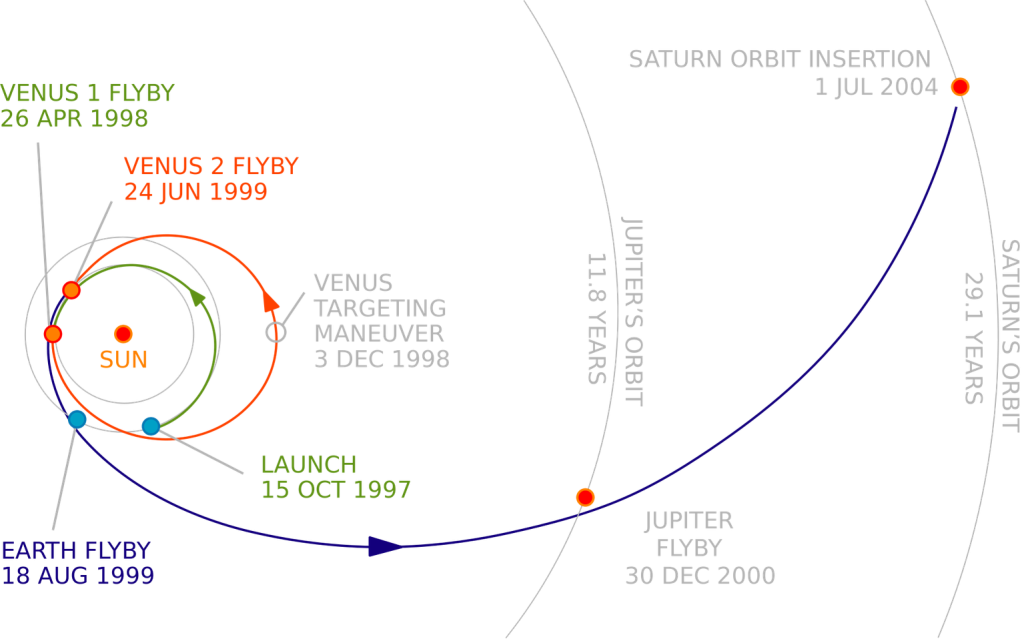
To solve this problem, engineers designed a trajectory known as the VVEJGA trajectory, which stands for Venus–Venus–Earth–Jupiter Gravity Assist.
Cassini was launched on 15 October 1997 aboard a Titan IVB rocket from Cape Canaveral. The spacecraft weighed over 5,600 kg, making it one of the heaviest interplanetary probes ever launched.
First Venus Flyby (April 1998)
The spacecraft first traveled inward toward Venus. During this close pass, Venus’s gravity increased Cassini’s heliocentric velocity and redirected its path back toward the Sun.
Second Venus Flyby (June 1999)
A second flyby of Venus further increased Cassini’s speed and adjusted the spacecraft’s orbit so that it would intersect Earth’s orbit.
Earth Flyby (August 1999)
Cassini then passed near Earth, gaining additional energy from Earth’s gravity. This maneuver boosted the spacecraft outward toward the asteroid belt and the orbit of Jupiter.
Jupiter Flyby (December 2000)
The flyby of Jupiter provided a powerful gravitational boost that accelerated Cassini significantly and placed it on its final trajectory toward Saturn.
During this encounter, Cassini also collected valuable scientific data about Jupiter.
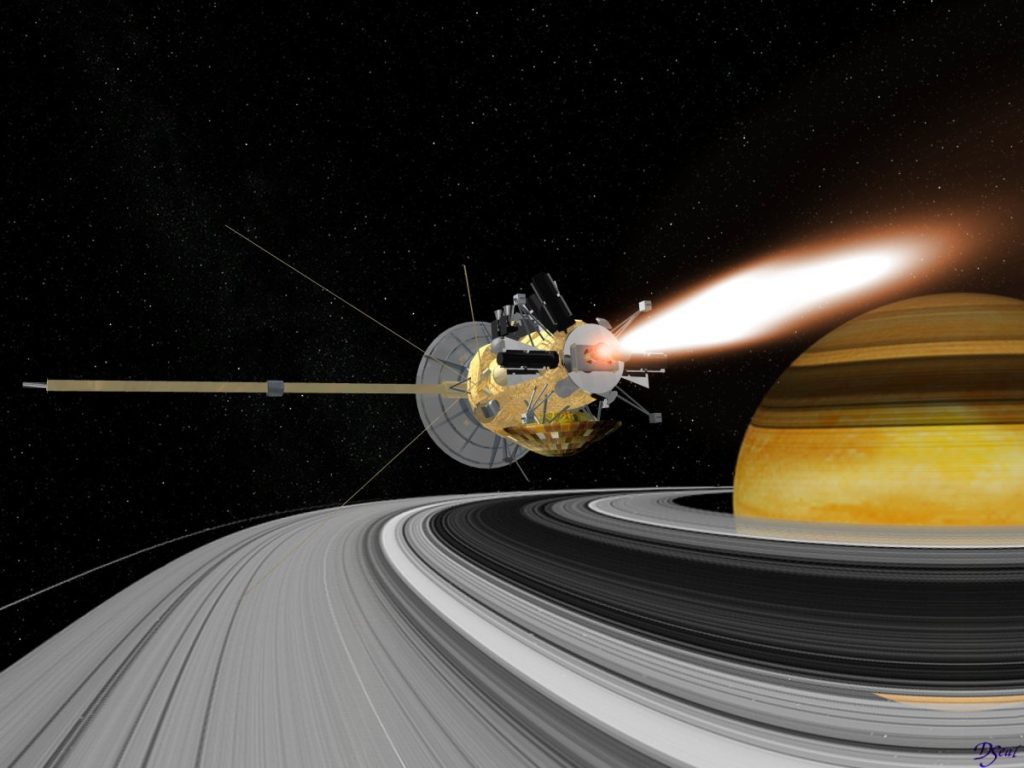
After a seven-year journey through the Solar System, Cassini arrived at Saturn on 1 July 2004. The spacecraft fired its main engine for about 96 minutes to slow down and enter Saturn’s orbit.
Once in orbit, Cassini began a long scientific mission studying:
- Saturn’s atmosphere and weather
- The structure of Saturn’s rings
- The chemistry and geology of its moons
The mission lasted 13 years in orbit, making it one of the most productive planetary missions ever.
The Cassini mission produced many major discoveries:
- Detection of water-rich plumes erupting from the moon Enceladus
- Detailed mapping of Saturn’s rings
- Discovery of methane lakes and rivers on Titan
- Long-term monitoring of Saturn’s storms and seasonal changes
In addition, the Huygens probe separated from Cassini and landed on Titan in January 2005, providing the first images from the surface of a moon in the outer Solar System.
To avoid contaminating potentially habitable moons such as Titan and Enceladus with Earth microbes, NASA ended the mission with a controlled descent into Saturn’s atmosphere on 15 September 2017. This final phase was called the Grand Finale, during which Cassini made multiple close passes between Saturn and its rings.
The Cassini mission demonstrates how gravity assists make ambitious planetary exploration possible. Without the use of planetary flybys, the spacecraft would have required either a much larger launch vehicle or far more fuel.
Gravity assist trajectories continue to be used in modern missions because they:
- Reduce fuel requirements
- Enable heavier spacecraft
- Expand mission possibilities across the Solar System
Future missions to the outer planets and even interstellar probes will likely continue to rely on gravity-assist techniques.
Gravity-assisted space travel is a powerful method that allows spacecraft to harness the natural motion of planets to reach distant destinations. By carefully planning flyby trajectories, engineers can dramatically increase spacecraft velocity without additional propulsion.
The Cassini mission to Saturn stands as a remarkable example of this technique. Using multiple gravity assists from Venus, Earth, and Jupiter, the spacecraft successfully reached Saturn and conducted one of the most important planetary exploration missions in history.