
Gate-Command Soft Start in Space Avionics
Case: Reducing 9A Inrush Current to 1A in Thermal Control Unit
- August 3, 2026
- CAVU Aerospace UK
Spacecraft electronics rely on large input capacitors to maintain stable power rails during rapidly changing loads. While these capacitors improve system stability, they also introduce one of the most common power integrity challenges in space electronics: start-up inrush current.
For Thermal Control Units (TCUs), an uncontrolled start-up can produce a very short but extremely high current pulse that stresses connectors, harnesses, protection devices, PCB copper, MOSFETs and spacecraft power distribution systems. Even though the event may only last a few hundred microseconds, it can determine the long-term reliability of the entire subsystem. We have gate-command soft-start mechanism that dramatically reduces start-up stress while maintaining virtually identical start-up energy and charging time.
When power is first applied, the input capacitors appear almost as a short circuit. If the power switch turns on instantly, the capacitors charge with a very large current pulse. High inrush current can cause nuisance fuse or electronic circuit breaker trips, connector arcing, excessive stress on MOSFETs, increased EMI, voltage droop on the spacecraft power bus & reduced lifetime of power distribution components.
A common solution is to control the MOSFET gate voltage, allowing the drain-source voltage to change gradually rather than instantaneously. By limiting the gate slew rate, the capacitor charging current is spread over a slightly longer interval, dramatically reducing the peak current.
Gate-Command Soft Start
Instead of applying the full gate drive immediately, the TCU commands the MOSFET through a controlled gate ramp. During startup, power is applied, MOSFET gate voltage increases gradually, input capacitors charge progressively & after the capacitors are charged, the MOSFET reaches full enhancement with minimal conduction loss. Unlike simple series resistors, this approach introduces almost no steady-state power loss while significantly reducing startup stress.

Measurement Results
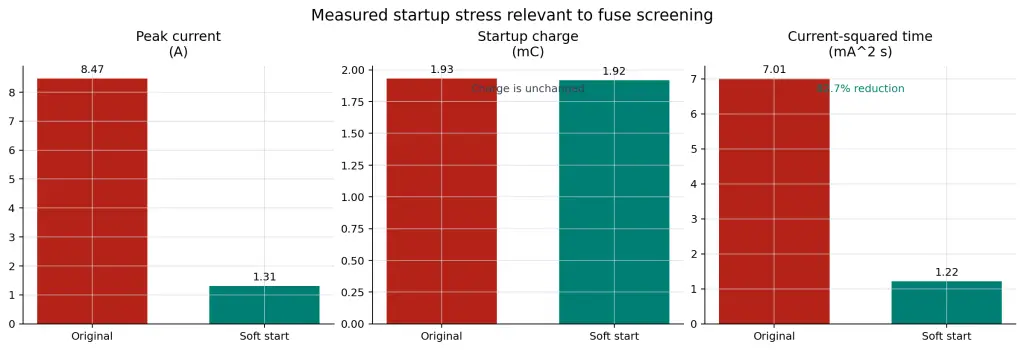
Laboratory measurements were performed using a 100 µs averaging window, representing the start-up stress relevant for fuse screening and spacecraft power distribution analysis.
The results are striking.
Parameter | Original Input Stage | Gate Soft Start |
Peak current | 8.47 A | 1.31 A |
Startup charge | 1.93 mC | 1.92 mC |
Current-squared time (I²t) | 7.01 mA²·s | 1.22 mA²·s |

The gate-command soft start achieved 85% reduction in peak current, 83% reduction in I²t stress & clearly unchanged startup charge. Although the charging current becomes much smaller, the total charge transferred into the input capacitors remains almost identical, confirming that the capacitors still receive the required energy. The charging process is simply controlled more gracefully.
Peak current alone does not fully describe electrical stress. Protection devices such as fuses are largely influenced by I²t. Because current is squared, reducing current has a disproportionately large benefit. In the TCU measurements:
- Peak current decreased from 8.47 A to 1.31 A
- I²t dropped from 7.01 to 1.22 mA²·s
This represents 83% reduction in start-up stress, significantly lowering the thermal energy delivered to protection devices and switching components. For spacecraft power systems, this reduction can increase fuse margin, reduce MOSFET heating, lower connector stress, improve long-term reliability & reduce conducted electromagnetic interference.
Simulation & Measurement
An equally important outcome is the close correlation between simulation and laboratory measurements.
Original input stage
Simulation predicted: Peak current: 8.33 A
Measured: Peak current: 8.47 A
Gate-command soft start
Simulation predicted: Peak current: 1.29 A
Measured: Peak current: 1.31 A
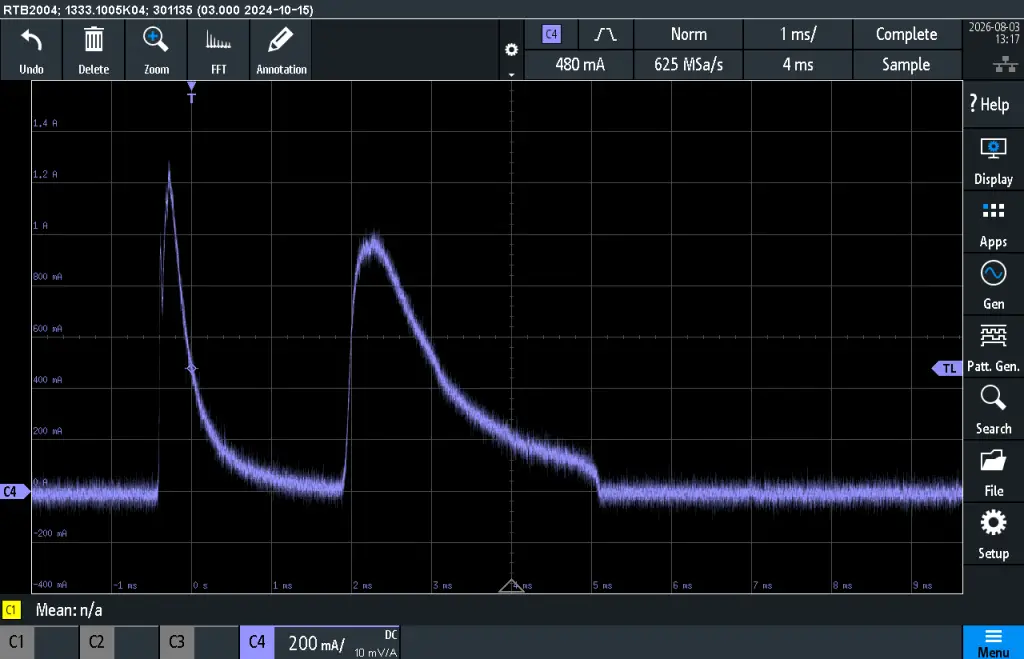
The waveform shapes also closely match throughout the startup event, demonstrating that the simulation accurately captures both the capacitor charging dynamics and MOSFET gate behavior. This strong correlation provides confidence that the validated model can be used to optimize future TCU designs with fewer hardware iterations.
Spacecraft power buses often supply multiple payloads and subsystems simultaneously. If several units start together, uncontrolled inrush currents can combine and overload the power distribution network.
The gate-command soft start offers several system-level benefits lower instantaneous demand on the spacecraft power bus, reduced stress on spacecraft fuses and electronic protection circuits, improved compatibility with current-limited power distribution architectures & reduced conducted EMI during startup.