Fast-Track Space Computing: Delayed Deliverables will be Free of Charge
- October 3, 2026
- CAVU Aerospace UK
In the space industry, time is often one of the most valuable resources. A delay in the delivery of an onboard computer can delay software development, system integration, environmental testing and, ultimately, the entire mission schedule. At CAVU Aerospace, we have therefore built our onboard computing business around one clear objective:
Get flight computing hardware into our customers’ hands as quickly as possible. Standard OBCs like PolarFire, TCU is delivered in less than a week! Our approach is simple: standardise wherever possible, customise only where necessary, and allow hardware and mission development to progress in parallel.
Standard hardware for faster missions
Many spacecrafts do not require a completely new onboard computer for every mission. Products such as OBC-Hyper-Polar, OBC-Cube-Polar, OBC-PF-VPX, Thermal Control Unit and Typhoon-Edge are designed as standard platforms covering a broad range of spacecraft requirements. Std. version of these OBCs is adequate for many missions or covering 90% of requirements, so it can help with faster development.
For example, Std. TCU can read 112 temperature sensors & drive 48 heater channels with 700W total power. While we have high-power TCUs with more than 5,000W power, std. TCU is still working for majority of space missions or at least as EM or Dev kit.
Where mission requirements can be met using our standard architecture and commercially available components, customers can use a proven CAVU platform without waiting for a completely bespoke computer to be designed and manufactured. Our COTS configurations are based on components supported for applications up to approximately 30 krad TID and 60 MeV SEE, subject to the specific component and mission configuration. This enables us to maintain standard hardware, documentation, manufacturing processes and development kits rather than starting every programme from a blank sheet of paper.
EM or Development hardware in less than a week
One of the biggest advantages of our standardised approach is the ability to provide standard OBC modules and development kits in less than one week for many projects, subject to stock availability and configuration. This means the customer’s software and systems teams can start development while the final flight hardware is still being prepared.
Instead of: Wait for the flight computer → start software development → integrate → test
the development process can become: Start with standard hardware & Board Support Package → develop software and system interfaces → integrate bespoke hardware in parallel → move to flight configuration
Bespoke OBC developed in parallel
Not every spacecraft can use a completely standard configuration. A mission may require a bespoke peripheral board for additional I/O, sensors, actuators, power interfaces, communications or other mission-specific functions. Rather than making the customer wait for the complete system, we can supply the standard OBC first.
While the customer is developing software and integrating the standard computer, CAVU develops the bespoke peripheral hardware in parallel. For many peripheral-board developments, our target delivery time is approximately 10–12 weeks, depending on complexity and requirements. The result is a parallel development model:
Standard OBC → immediate customer development
Bespoke peripheral → developed in parallel
Final integrated system → delivered when both are ready
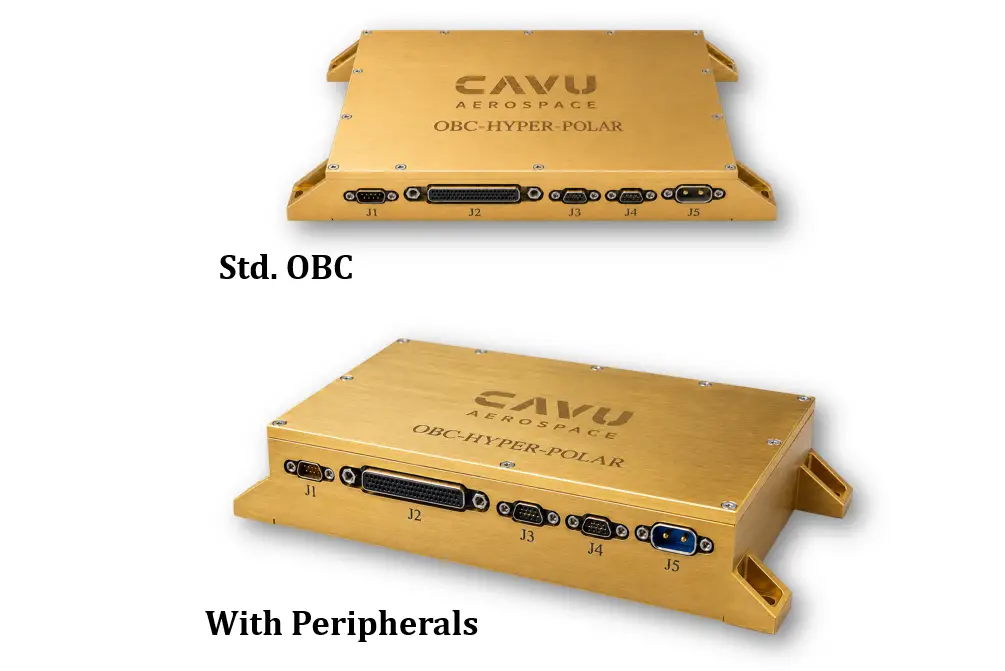
This approach has already been successfully applied across multiple mission programmes. Specially with OBC-Hyper-Polar we have fitted several add-on cards including extra Ethernet ports, drivers for heaters, solenoids, valve controls, stepper motors etc. While Std. OBC-Hyper-Polar with more than 40 GPIO was used in development stage with fast delivery & fraction of the costs.
From COTS to radiation-tolerant configurations
For missions requiring higher radiation performance—particularly GEO and other demanding environments—the supply chain is different. Radiation-tolerant components can have significantly longer procurement lead times, and these components can become the determining factor in the overall delivery schedule. For these configurations, typical lead times are approximately 5–9 months, depending on the required radiation-tolerant components, availability and configuration. Where the mission permits COTS-based hardware, however, we can avoid many of these component lead-time constraints and provide a much faster route to development hardware and flight computing.
Fast Delivery Commitment
CAVU provides a straightforward commercial commitment. Any delayed deliverable will be free of charge.
If a deliverable covered by our agreed delivery commitment is delayed due to CAVU, the delayed deliverable will be supplied at no charge. This is more than a statement about manufacturing speed. It reflects the way we approach customer programmes. We plan production around agreed milestones, maintain standard hardware wherever possible, and use parallel development to reduce dependencies between the customer’s programme and our own development activities.
Fast delivery does not mean cutting corners. Space hardware still requires the appropriate design reviews, manufacturing controls, testing, documentation and verification for its intended application. Our objective is different: remove unnecessary waiting time from the development process by supplying standard pre-built hardware which covers all or majority of requirements. This also will help reducing manufacturing costs with roll production.