Enabling Thermal Stability for Deep Space Missions, 1% Closer to Sun
- March 21, 2026
- CAVU Aerospace UK
As spacecraft venture deeper into the Solar System, thermal management becomes one of the most critical engineering challenges. Even seemingly small changes in solar distance can have significant consequences on spacecraft performance and reliability.
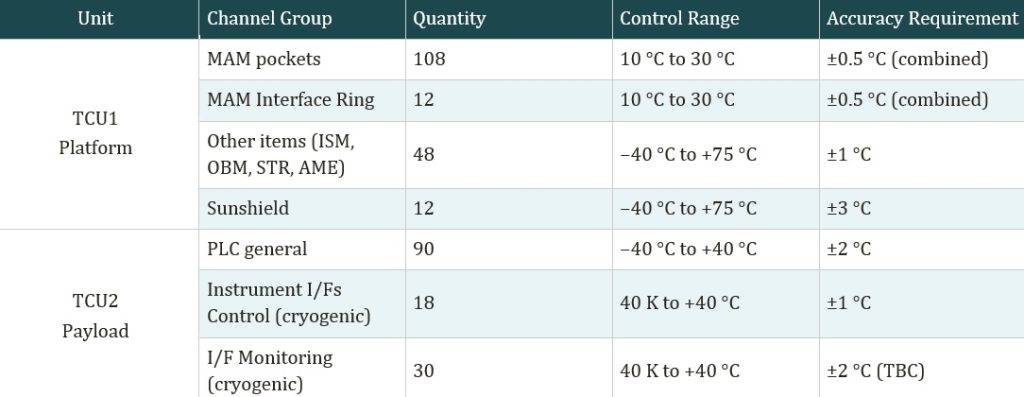
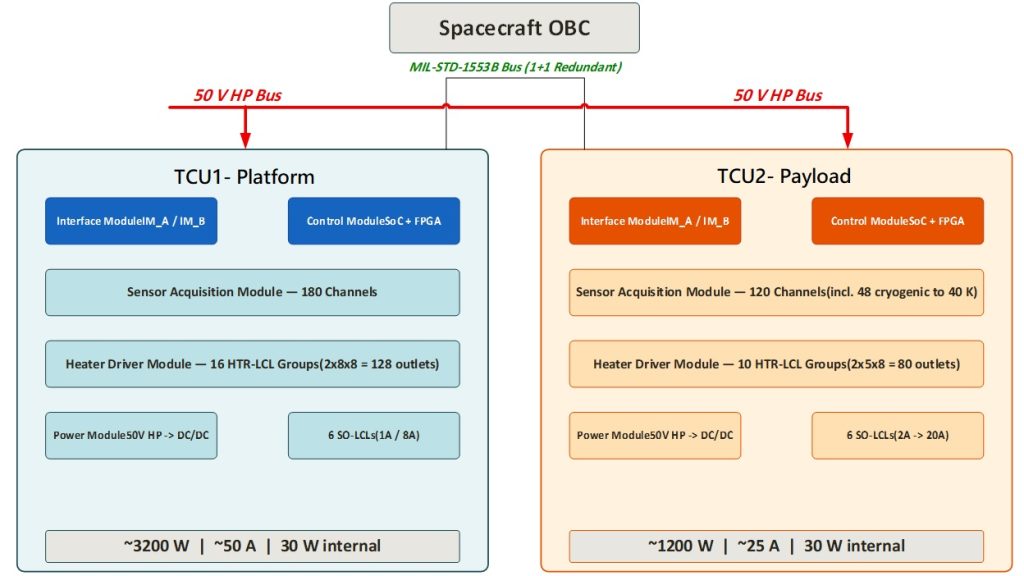
We suggest two advanced Thermal Control Units (TCUs)—one dedicated to the spacecraft platform with 180 measurement channels (TCU1) and the other to its payload with 120 channel (TCU2) to guarantee smooth operation of spacecraft & scientific payloads.
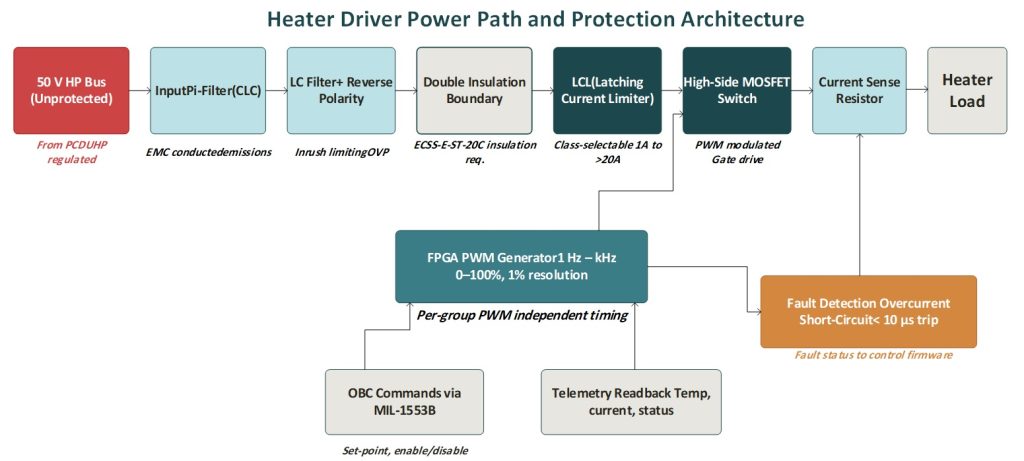
Both thermal management units drive heaters directly. TCU1 has 128 heaters to drive totally 3200 W & TCU2 has 80 channels with 1200 W total power. Some details are described in this article.
The Challenge: Operating Closer to the Sun
This mission operates at a point approximately 1% closer to the Sun than typical Earth-orbiting spacecraft. While this may appear marginal, the physics tells a different story.
Solar radiation follows an inverse-square relationship, meaning even small reductions in distance can result in measurable increases in thermal load. For sensitive spacecraft systems, this translates into:
- Elevated component temperatures
- Increased thermal gradients
- Higher demand on heat rejection systems
- Greater risk to mission-critical electronics and instruments
In deep space environments—where convection is absent—thermal control relies entirely on radiation and conduction, making precise control essential.
Dual TCU Architecture
To address these challenges, CAVU Aerospace suggests two independent Thermal Control Units:
- Platform TCU
Responsible for maintaining thermal stability across the spacecraft bus, including:
- Onboard computers
- Power systems
- Avionics and control electronics
This unit ensures the spacecraft’s core systems remain within strict operational limits throughout varying mission phases.
- Payload TCU
Dedicated to the payload subsystem, which often includes:
- Scientific instruments
- Optical assemblies
- Sensors with tight thermal tolerances
Payload performance is highly sensitive to temperature fluctuations, and even minor deviations can impact data quality and measurement accuracy.
Precision Thermal Management
The TCUs are designed to provide:
- High-resolution temperature sensing and control
- Efficient heater management for cold environments
- Optimized heat distribution and rejection strategies
- Robust operation across dynamic thermal conditions
By separating platform and payload thermal control, the system enables:
- Independent optimisation of thermal loops
- Reduced thermal interference between subsystems
- Improved overall system reliability
Thermal control is often an invisible subsystem, yet it is fundamental to mission success. In deep space missions, where repair is impossible, maintaining thermal balance is essential for:
- Electronics longevity
- Instrument accuracy
- Structural integrity
- Overall mission lifetime
A deviation of just a few degrees can mean the difference between nominal operation and mission failure.
Supporting the Future of Deep Space Exploration
With this dual-TCU delivery, CAVU Aerospace continues to advance its role in high-reliability spacecraft subsystems, supporting missions that push the boundaries of exploration.
By addressing the thermal challenges of operating closer to the Sun, this solution ensures that both platform and payload systems perform optimally, even in demanding deep space conditions.
As space missions become more ambitious, precision thermal control is no longer optional—it is mission-critical.
CAVU Aerospace’s dual Thermal Control Unit architecture provides a robust, scalable, and high-performance solution, enabling spacecraft to operate safely and effectively in environments where even a 1% change in solar distance matters.