
Embedded Vision Interface in Thermal Control Unit
- May 15, 2026
- CAVU Aerospace UK
The thermal subsystem has always been one of the most critical elements of spacecraft reliability. Traditionally, a Thermal Control Unit (TCU) is responsible for monitoring temperature sensors and driving heaters to maintain equipment within operational limits. We designed our TCU platform to go far beyond conventional thermal management.
By integrating high-speed networking capabilities, Gigabit Ethernet, and multiple serial interfaces into the architecture, the TCU has evolved into a compact spacecraft subsystem controller capable of supporting advanced payload and monitoring applications, data logging alongside its primary thermal duties.
- FTP logging and file service to store telemetry and housekeeping logs on eMMC, with start/stop control and status reporting.
- gRPC unary server for remote command execution (ping, configuration, telemetry, control, logging commands) over TCP/IP.
- SNTP client to synchronize device RTC time from a network time server.
- RTC management for read/write timekeeping and timestamped logging.
- Heater and thermistor control pipeline for configuration, state control, and power/temperature readback.
- Housekeeping telemetry acquisition and converted engineering-value reporting.
- eMMC management features including filesystem operations and format command.
- RS232 and RS422 command compatibility path alongside network gRPC control.
- FreeRTOS-based multitask firmware architecture with lwIP networking and protocol services.
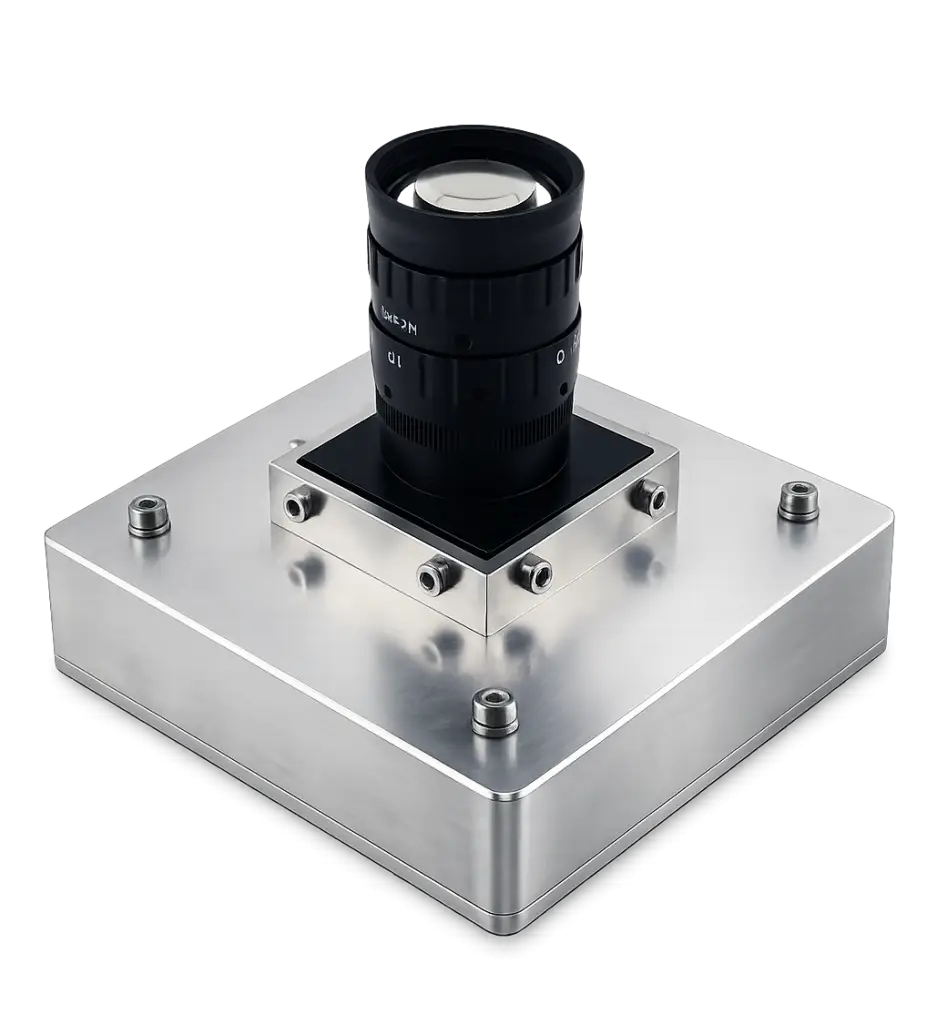
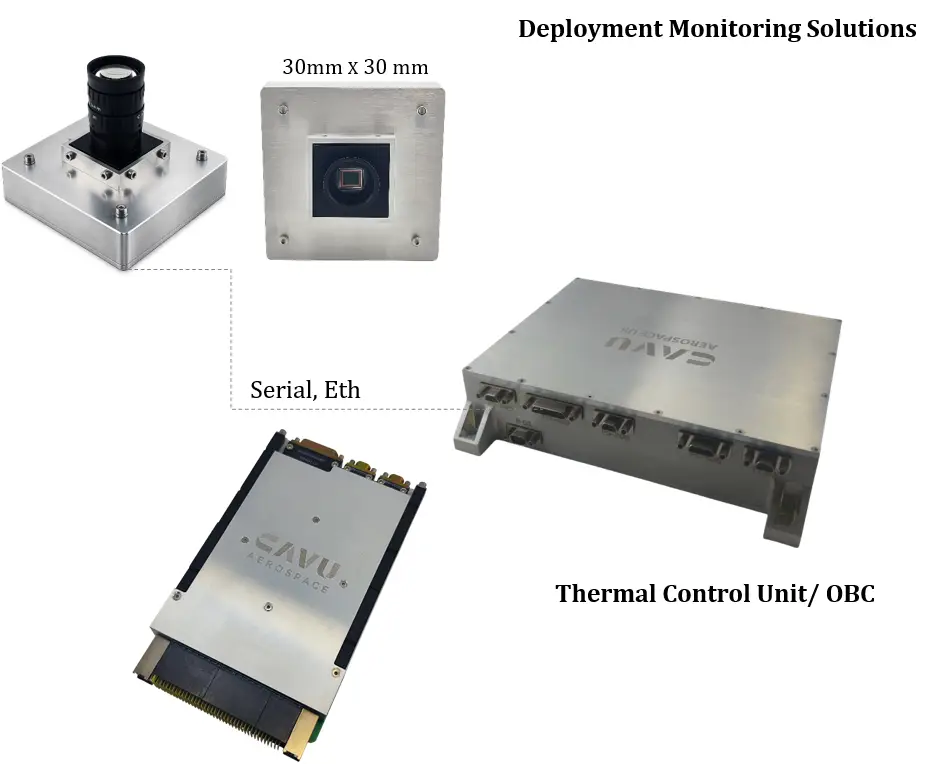
One of the latest demonstrations of this capability is the successful interface of the Alvium 1800 camera family into the TCU for spacecraft deployment monitoring applications. This enables satellite projects to develop data logging, data handling & monitoring solution in single sub-system.
Most thermal control electronics in small satellites and CubeSats focus exclusively on:
- Reading thermistors, RTDs, Custom analog or thermal cameras
- Controlling survival and operational heaters
- Executing thermal protection logic
- Communicating telemetry to the onboard computer
Modern missions, however, increasingly require subsystem consolidation to reduce mass, volume, harness complexity, power consumption & development cost. To address this challenge, the TCU platform was architected with significantly expanded connectivity options, including:
- Gigabit Ethernet interfaces
- Multiple serial communication channels
- Flexible embedded processing capability
- High-speed data adaptation functionality
- FTP logging
This allows the TCU to operate not only as a thermal controller, but also as a distributed intelligent subsystem node.
Integrated Embedded Vision Capability
A development project demonstrated the TCU’s ability to interface with compact industrial-grade imaging systems for onboard monitoring tasks. The integrated solution uses the Alvium 1800 camera platform as an ITAR-Free competitive & handy camera, a compact embedded vision camera series designed for high-performance industrial and embedded imaging applications. The developed architecture performs three key functions:
- Acquisition of image data from the camera
- Adaptation and formatting of image/video data, compress, reduce data rate
- Delivery of processed information to the TCU through a serial interface
This effectively enables the TCU to receive and manage deployment-monitoring imagery without requiring a dedicated high-performance payload computer.
Deployment Monitoring in Space Applications
One of the primary target applications for this capability is spacecraft deployment observation. During orbital operations, deployment events are among the highest-risk mission phases, including solar panel deployment, antenna release, boom extension, payload separation & mechanism actuation.
Historically, these events were difficult to observe directly due to spacecraft resource constraints. The integration of compact embedded cameras now allows spacecraft operators to obtain visual confirmation of deployment success. Our solution enables compact camera systems to stream deployment imagery through an adaptation layer directly into the TCU infrastructure. This architecture creates several advantages:
- Reduced subsystem count
- Simplified spacecraft integration
- Lower power requirements
- Shared communications infrastructure
- Compact and modular implementation
The result is a highly efficient deployment-monitoring capability suitable for small satellites and resource-constrained missions.
Modern embedded vision systems have become increasingly attractive for aerospace applications due to advances in low-power image sensors, compact optics, high-speed embedded interfaces, edge processing capability while keeping costs & lead times in minimum.
At the spacecraft level, this enables a new class of applications deployment verification, internal spacecraft monitoring, mechanism inspection, situational awareness & payload observation support. By integrating these capabilities into an already flight-proven subsystem such as the TCU, mission designers can avoid introducing entirely separate imaging computers into the spacecraft architecture.
Toward Smarter Spacecraft Subsystems
A key differentiator of the TCU is its modular network-oriented design philosophy. The inclusion of Gigabit Ethernet interfaces and multiple serial channels allows the unit to act as an integration hub between sensors, cameras, payload electronics, onboard computers & other subsystems. This flexibility supports future mission architectures where subsystem boundaries become increasingly software-defined rather than hardware-limited. The camera integration project demonstrates how a thermal controller can evolve into a multifunction spacecraft interface platform while still maintaining its core thermal management responsibilities.