
Dual-Camera JAE Interface: Enabling High-Performance Onboard Live Intelligence with Typhoon Edge
- August 17, 2026
- CAVU Aerospace UK
Modern Earth-observation, surveillance and space-based intelligence missions are generating more sensor data than can practically be transmitted to the ground. High-resolution cameras can produce enormous volumes of imagery, while the most valuable information may represent only a small fraction of the total data collected. When we are talking about High-Performance intelligence, it means it should have different types of onboard camera (several visible cameras in multi-angle positions and an infrared camera for example) to extract high-value data. The challenge is therefore no longer simply to acquire images. The challenge is to acquire, process, understand and act on sensor data directly onboard the spacecraft.
Typhoon Edge has been designed around this requirement. By combining a 248-TOPS NVIDIA Jetson AGX Orin Industrial accelerator with a Microchip PolarFire SoC MPFS460T, and providing two dedicated high-speed camera interfaces through compact 51-contact JAE connectors, Typhoon Edge creates a powerful platform for dual-sensor acquisition and real-time onboard intelligence.
At the center of the architecture is the NVIDIA Jetson AGX Orin Industrial module, operating at up to 75 W and delivering up to 248 TOPS of AI performance. With 64 GB ECC LPDDR5 memory and up to 204.8 GB/s memory bandwidth, the platform provides substantial compute capability for demanding onboard workloads.
Two independent XIMEA cameras can be connected directly to Typhoon Edge through two dedicated 51-contact JAE interfaces. Each camera interface provides its own:
- PCIe Gen2 x4 data path
- Protected 12 V camera power
- Trigger capability
- General-purpose I/O
- Dedicated physical interface
This architecture allows the two cameras to operate as independent acquisition channels rather than competing for a single shared interface. The result is a clean and deterministic path:
Camera
▼
Dedicated JAE Interface
▼
PCIe Gen2 x4
▼
Jetson AGX Orin
▼
AI Processing
▼
Storage / Network / Spacecraft Decision
This direct connection is particularly valuable when high-resolution imagery must be processed immediately after acquisition.
In a conventional architecture, multiple cameras may share data links, external acquisition hardware or a common interface that introduces bandwidth limitations and additional system complexity. The Typhoon Edge JAE implementation takes a different approach. Each XIMEA camera receives its own dedicated PCIe Gen2 x4 root-port path. This provides several important advantages:
Independent High-Speed Data Acquisition- Each camera can transfer data through its own dedicated PCIe connection, reducing contention between the two imaging channels. This is particularly important when both cameras are operating simultaneously—for example:
- A visible camera and an infrared camera
- Two cameras observing adjacent ground areas
- Stereo or multi-angle imaging
- Wide-area monitoring combined with high-resolution target observation
- Simultaneous surveillance and tracking
Simplified Payload Integration- The 51-contact JAE connector combines the essential camera services into a compact interface, including high-speed data connectivity, power and control signals.
Instead of requiring separate connectors for data, power and triggering, the camera interface provides an integrated connection designed specifically for the payload architecture. This can help reduce harness complexity, connector count, integration effort, potential failure points & payload volume. For spacecraft designers, this means a cleaner mechanical and electrical integration between the imaging payload and the onboard computer.
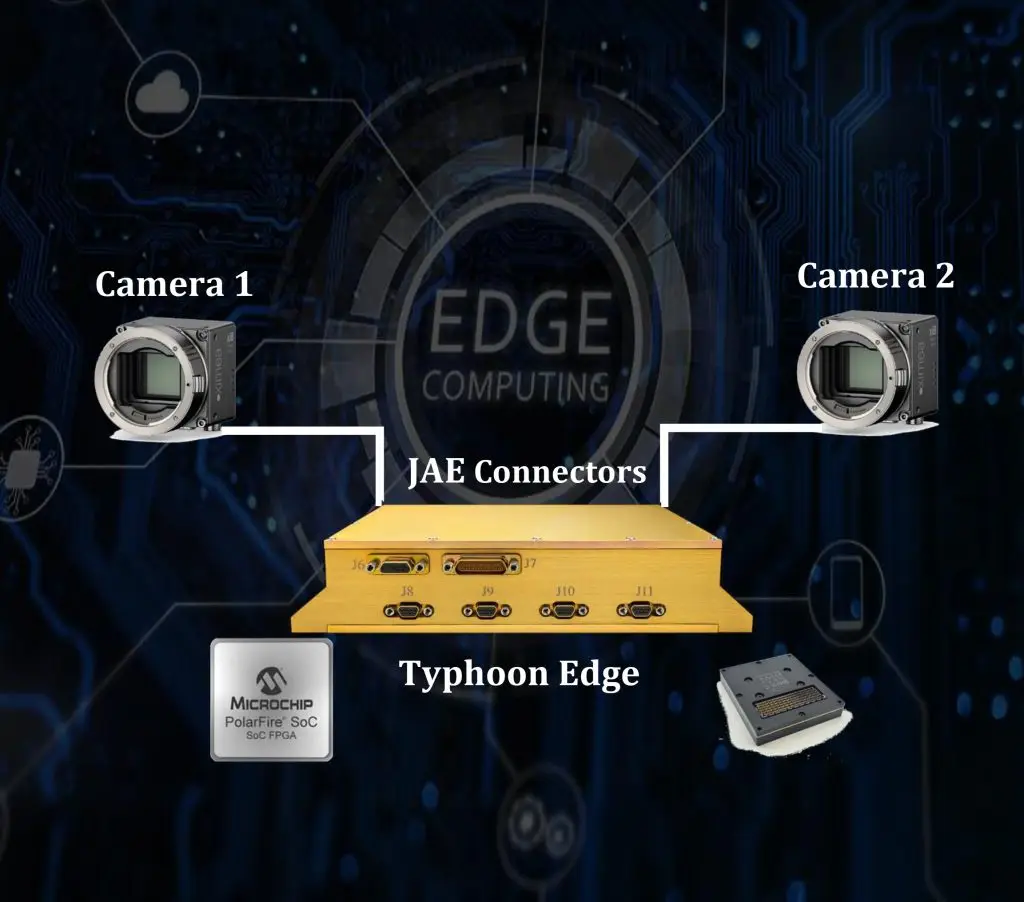
Two Cameras, One Intelligent Processing Platform
The real advantage of the architecture appears when dual-camera acquisition is combined with onboard AI. Typhoon Edge can receive imagery from both cameras and use the Jetson AGX Orin to execute AI algorithms directly onboard the spacecraft. For example, one camera may continuously observe a large area while the second camera performs detailed monitoring of a selected region. In a small satellite platform, we can have several OBCs & each can deliver data handling of few different type cameras. The onboard AI system like PolarFire + Jetson GPU can:
- Acquire imagery from both cameras.
- Analyse the incoming data in real time.
- Detect objects, changes or events of interest.
- Correlate information from both sensors.
- Select important imagery or targets.
- Store only the most valuable data.
- Send intelligence, alerts or selected imagery to the ground.
This transforms the spacecraft from a passive data collection platform into an intelligent edge-processing system.
Supporting Space-Based Intelligence Applications
The multi-camera architecture is particularly suitable for missions where rapid detection and decision-making are required. We might have up to 10 cameras with different types & different angles like visible, infrared to generate required precision in intelligence.
Environmental Monitoring- One camera can monitor a wide geographical region while onboard AI searches for events such as wildfires, smoke plumes, flooding, oil spills, changes in vegetation or volcanic activity. When an event is detected, the second camera can support higher-detail observation or continued tracking. Instead of transmitting every frame to the ground, the spacecraft can identify the relevant information onboard.
Maritime Surveillance- Dual cameras can support the detection and tracking of vessels across large areas. AI algorithms running on the Jetson AGX Orin can potentially perform vessel detection, object classification, ship tracking, behaviour analysis & change detection. Information from multi-imaging channels can also provide additional confidence before an event is reported.
Ground Vehicle Detection and Tracking- For intelligence and security applications, one camera can provide persistent area observation while the second camera focuses on a region or target of interest. The AI accelerator can process imagery onboard to identify vehicle movements, changes in infrastructure, unusual activity, convoy movement & repeated patterns of activity. This can significantly reduce the amount of raw imagery that needs to be transmitted through a limited satellite downlink.
Multi-Spectral and Multi-Sensor Fusion- The two dedicated camera links also create opportunities for combining different sensor types. For example: Visible + Near-Infrared, Visible + Thermal, Wide-angle + Narrow-angle, High-resolution + Context camera. Several camera with different types can be connected with same JAE connectors to Typhoon-Edge & work reliable in space while process information from both sources and support sensor-fusion algorithms that generate more useful intelligence than either camera could provide independently.
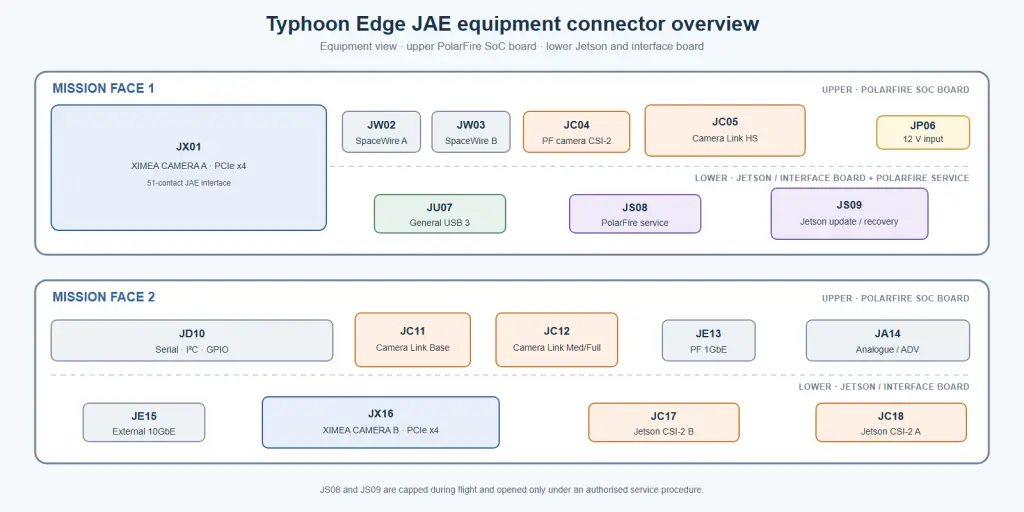
More Than an AI Computer: A Supervised Flight Architecture
High AI performance alone is not sufficient for a spacecraft. Typhoon Edge combines the Jetson AGX Orin with a Microchip PolarFire SoC MPFS460T, which acts as a trusted and deterministic supervisory authority for the platform.
The PolarFire SoC can manage critical functions including:
- Power supervision
- Reset control
- Hardware watchdog functions
- Payload custody
- Telemetry
- Fault Detection, Isolation and Recovery (FDIR)
- Deterministic FPGA preprocessing
- Camera and payload control
This separation is an important architectural advantage. The Jetson AGX Orin can focus on computationally intensive AI workloads, while the PolarFire SoC maintains supervisory authority and deterministic control over essential spacecraft functions. The Jetson provides the intelligence, while the PolarFire SoC provides the supervision and deterministic control required for a robust spacecraft computing architecture.
This combination is particularly attractive for autonomous missions where the spacecraft must continue operating safely even when the AI processor is executing complex workloads or recovering from a software fault.
Flexible Camera and Sensor Ecosystem with same simple harness- JAE
Although the JAE version is designed to provide dedicated support for two XIMEA cameras, the Typhoon Edge architecture maintains a broader range of acquisition capabilities. The platform also includes:
- Two four-lane Jetson CSI-2 inputs
- One PolarFire camera CSI-2 / auxiliary-LVDS input
- Copper Camera Link HS
- Camera Link Base, Medium and Full acquisition
This creates a highly flexible platform for missions involving multiple imaging technologies or specialised payloads. The dual JAE interfaces therefore provide a dedicated high-speed solution for the primary cameras while the remaining acquisition interfaces can support additional sensors, auxiliary cameras or specialised payload equipment.
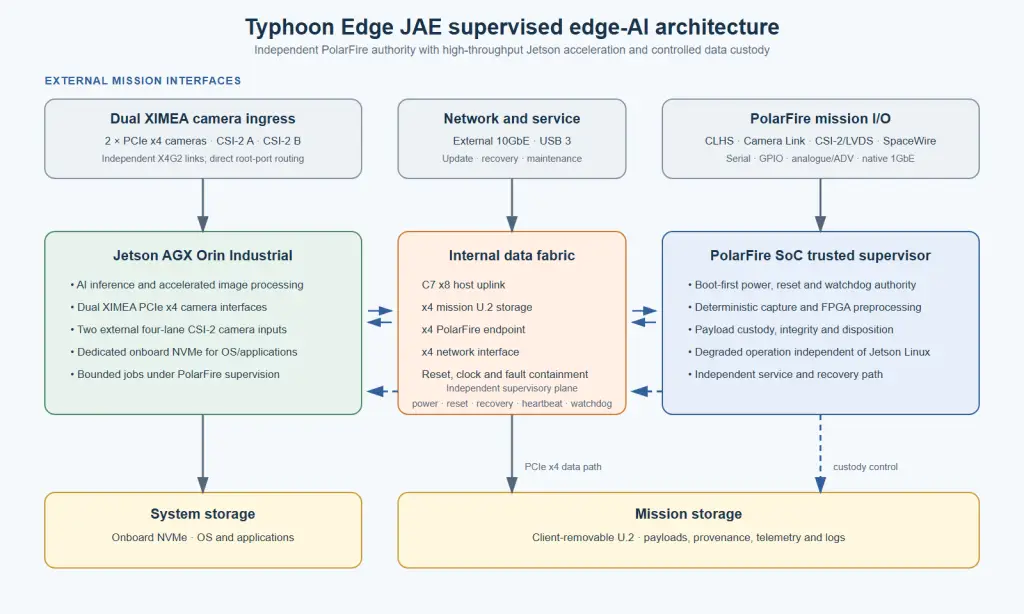
Data Storage and Distribution
Processing data onboard is only part of the challenge. Intelligent payload systems must also reliably manage the information they generate. Typhoon Edge includes:
- A dedicated 1 TB system NVMe
- A 1.92 TB baseline client-removable U.2 mission SSD
- External 10GbE copper
- Native PolarFire 1GbE
- Dual SpaceWire
This allows the system to support a complete onboard data pipeline. For example:
Dual Cameras
▼
Dedicated PCIe Gen2 x4 Acquisition Paths
▼
Jetson AI Processing
▼
Target Detection / Classification / Sensor Fusion
▼
PolarFire Supervision and Deterministic Processing
▼
Mission SSD Storage
▼
10GbE / 1GbE / SpaceWire Distribution
The spacecraft can therefore acquire, understand, store and distribute information without requiring continuous ground intervention.
The Typhoon Edge with JAE connectors is implemented as a conduction-cooled flight unit. Heat generated by the high-performance Jetson processor is transferred through heat pipes to the spacecraft cold plate, allowing operation in vacuum without relying on fans.
The system supports 12 V to 36 V DC input, 150 W maximum power, protected power entry, Protected 12 V camera power, Conduction cooling. This allows a powerful terrestrial-class AI accelerator to be integrated into a spacecraft-oriented thermal and power architecture.
Secure Software Updates for Long-Duration Missions
Onboard intelligence capabilities will continue to evolve after launch. New AI models, improved detection algorithms and updated flight software may all be required during the operational life of the spacecraft. Typhoon Edge supports signed software releases, A/B software images, supervised updates & automatic rollback. This architecture can help spacecraft operators deploy updated software while retaining a known working version as a recovery option. The ability to update AI capabilities in orbit means that the spacecraft’s intelligence can evolve throughout the mission rather than being permanently fixed at launch.
A Platform for the Next Generation of OnBoard Intelligent Spacecraft
The Typhoon Edge demonstrates how high-performance AI computing and high-speed camera acquisition can be integrated into a single supervised flight architecture. By providing two independent 51-contact JAE camera interfaces, each with its own PCIe Gen2 x4 data path, protected camera power and control I/O, the system creates a direct and efficient connection between dual imaging payloads and the NVIDIA Jetson AGX Orin AI accelerator. Combined with the supervisory capability of the PolarFire SoC MPFS460T, high-speed storage, networking and SpaceWire interfaces, Typhoon Edge provides much more than an onboard computer. It becomes a complete platform for space-based edge intelligence.
For missions involving environmental monitoring, wildfire detection, maritime surveillance, vehicle tracking, change detection, multi-sensor fusion and autonomous spacecraft operations, the ability to connect two high-performance cameras directly to an onboard AI platform can fundamentally change how satellite data is handled. Rather than sending every image to the ground and waiting for analysis, Typhoon Edge enables the spacecraft to start understanding what it sees while it is still in orbit.
Typhoon Edge— Key Architecture Highlights
- 248 TOPS NVIDIA Jetson AGX Orin Industrial AI acceleration
- 64 GB ECC LPDDR5
- 204.8 GB/s memory bandwidth
- PolarFire SoC MPFS460T trusted supervisory architecture
- Two independent XIMEA camera interfaces
- Two dedicated PCIe Gen2 x4 root-port paths
- 51-contact JAE connectors with data, power and control integration
- Protected 12 V camera power
- Trigger and general-purpose I/O
- Additional CSI-2, LVDS and Camera Link acquisition capability
- 1 TB system NVMe + 1.92 TB removable U.2 mission storage
- 10GbE, 1GbE and dual SpaceWire
- Conduction-cooled, fanless operation in vacuum
- Signed A/B software releases with supervised updates and rollback