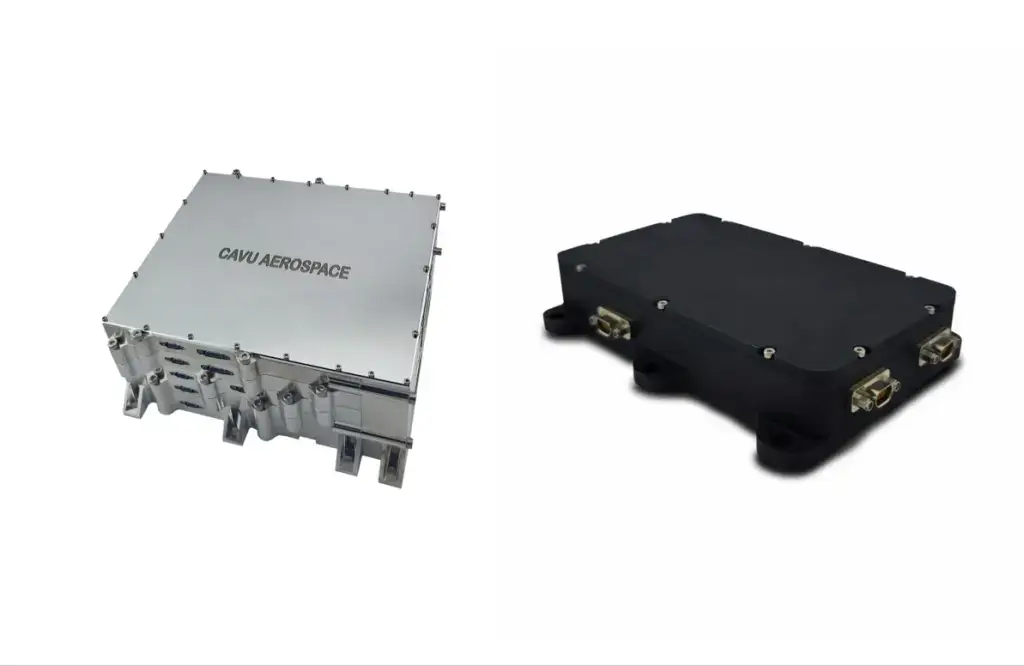
Chromate Conversion Coating vs Black Anodizing for Spaceborne Electronics Chassis
- June 15, 2026
- CAVU Aerospace UK
Spaceborne electronics such as On-Board Computers, Power Units, communication systems, and payload electronics are typically housed within aluminium enclosures designed to provide structural integrity, electromagnetic shielding, thermal management, and environmental protection.
Aluminium alloys such as 6061-T6 and 7075-T6 are commonly used for electronics enclosure box due to their excellent strength-to-weight ratio, machinability, and thermal conductivity. Traditionally, these enclosures are finished using chromate conversion coating (CCC), often referred to by trade names such as Alodine. Increasingly, spacecraft integrators are requesting black anodized finishes, particularly for small satellites and CubeSat missions.
Although both surface treatments provide corrosion protection, they serve very different engineering purposes. Selecting the wrong finish can adversely affect thermal performance, electrical bonding, EMC compliance, and overall spacecraft thermal balance.
Chromate Conversion Coating (CCC)
Chromate conversion coating is a chemical treatment that converts the outermost aluminium surface into a thin, protective oxide-chromate layer. Because the coating is extremely thin, the enclosure effectively retains the electrical and thermal properties of bare aluminium. Typical characteristics include:
- Coating thickness less than 5μm
- Minimal dimensional change
- Good corrosion resistance
- Excellent electrical conductivity
- Minimal effect on thermal conductivity
- Compatible with grounding and EMI shielding requirements
Black Anodizing
Anodizing is an electrochemical process that grows a controlled aluminium oxide layer on the surface of the metal. Main characteristics are listed here:
- Thickness 10–25μm
- Hard and wear-resistant surface & Excellent corrosion protection
- Electrically insulating surface
- High thermal emissivity and
- Significant impact on optical properties
The resulting oxide layer is substantially thicker than chromate conversion coating and fundamentally changes how the surface interacts with heat, sunlight, and electrical currents. When dyed black, the surface acquires optical characteristics that can significantly influence spacecraft thermal behaviour.
Radiation Protection
Radiation protection is almost entirely determined by the aluminium wall thickness.4.75 mm AL6061-T6 or AL7075-T6 which is common thickness in enclosure box of OBCs CAVU Aerospace provide the vast majority of the shielding against trapped electrons, protons, solar particle events & secondary radiation effects. Consequently, neither black anodizing nor chromate conversion coating should be selected on the basis of radiation shielding performance.
Thermal Performance in Orbit
The most important difference between the two coatings is thermal behaviour. Spacecraft thermal engineers are primarily interested in two optical properties: α (Solar Absorptance- How much incoming solar energy a surface absorbs) & ε (Infrared Emittance- How effectively the surface radiates heat into space). The ratio α/ε largely determines whether a surface tends to heat up or cool down.
For Chromate Conversion Coating typical values:
- Solar absorptance (α): 0.2–0.4
- Infrared emittance (ε): 0.05–0.2
It absorbs relatively little solar energy, does not radiate heat efficiently & tends to retain internally generated heat. This can be advantageous when electronics require thermal stability or when the enclosure is not intended to function as a radiator.
For Black Anodized Aluminium typical values are:
- Solar absorptance (α): 0.85–0.95
- Infrared emittance (ε): 0.80–0.90
It absorbs significantly more solar energy, radiates heat very efficiently & acts as a good thermal radiator. This makes black anodizing attractive for spacecraft surfaces intended to reject waste heat.
Chromate conversion coating is generally preferred when the enclosure’s primary role is structural and electrical rather than thermal. For example in internal avionics boxes when the enclosure is mounted inside a spacecraft bus and is not directly exposed to space, thermal radiation from the enclosure surface is often of limited importance & electrical bonding becomes critical, grounding requirements dominate & EMI shielding effectiveness is important. So Chromate conversion coating offers clear advantages.
Many OBCs rely on low-resistance electrical interfaces among lid and enclosure, enclosure and spacecraft structure & connector shells and chassis. Chromate conversion coating maintains conductivity across these interfaces. Black anodizing introduces an insulating oxide layer that can significantly increase contact resistance.
When the spacecraft thermal design already provides adequate temperature control through dedicated radiators, heat straps & thermal interfaces, there may be little benefit in using black anodized electronics housings.
When Black Anodizing is the Better Choice
Black anodizing becomes advantageous when thermal management or optical performance is important. Many CubeSat and SmallSat missions use external electronics housings as part of the spacecraft thermal control system. In such cases, the chassis itself may serve as a radiator. Black anodizing significantly improves heat rejection.
For electronics dissipating substantial power, such as OBCs, AI enables OBCs, SDR communication systems or payload processing units, black anodizing can help reduce operating temperatures by increasing radiative heat loss.
If the chassis is mounted externally and exposed to deep space, thermal engineers often select black anodized surfaces to achieve desired temperature control characteristics. The finish becomes part of the spacecraft thermal model.
Optical sub-systems
Black anodized surfaces are frequently used around optical payloads, star trackers and cameras because they suppress reflections and reduce stray light. For these applications, optical performance rather than thermal performance may drive the selection.
While black anodizing offers thermal advantages, several engineering issues must be addressed. The anodized oxide layer is electrically insulating. This can create problems for grounding, EMC performance, chassis bonding & lightning and ESD protection during testing.
Our recommendation:
For most spacecraft electronics chassis, the choice should be driven by system requirements rather than appearance. Chromate conversion coating is generally preferred when:
- Electrical conductivity is important
- EMC performance is critical
- The enclosure is internal to the spacecraft
- Thermal radiation from the housing is not required
- Tight mechanical tolerances must be maintained
Black anodizing is generally preferred when:
- The enclosure contributes to thermal control
- Heat rejection is required
- Optical reflection must be minimized
- The housing is externally exposed
- The spacecraft thermal model specifically requires high emissivity surfaces