Captures from Saturn's auroral emissions are similar to Earth's Northern Lights
Credit: NASA
- March 16, 2026
- CAVU Aerospace UK
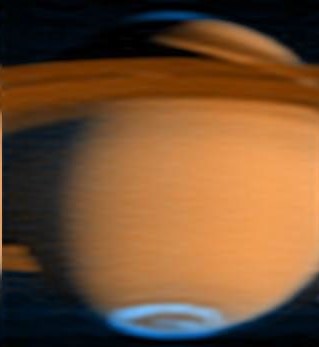
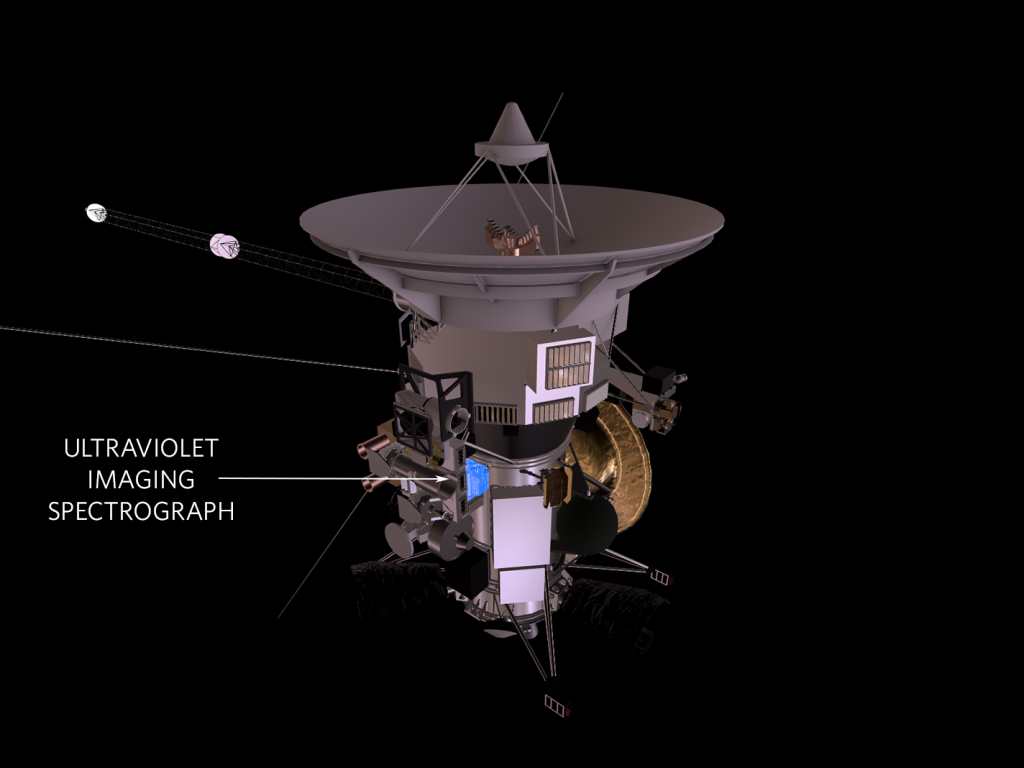
Ultraviolet Imaging Spectrograph was one of the most important payloads at Cassini spacecraft. It did a lot of science which helped a lot to expand our consciousness on universe. But it also captured amazing auroral emissions at Saturn, very similar to Northern Lights we see quite often on Earth!
Developed by the Laboratory for Atmospheric and Space Physics, UVIS was a remote-sensing instrument designed to observe ultraviolet light reflected or emitted by objects within the Saturn system. The instrument measured ultraviolet radiation across wavelengths ranging from 55.8 to 190 nanometers, allowing scientists to analyze atmospheric composition, particle distributions, aerosols, and temperature structures.
Instrument Overview
UVIS consisted of a two-channel spectrograph system capable of observing both far-ultraviolet and extreme-ultraviolet wavelengths. These capabilities enabled the instrument to capture detailed UV images and spectra of Saturn and its environment.
Key specifications:
- Mass: ~14.46 kg
- Peak operating power: ~11.83 W
- Peak data rate: ~32.096 kbps
- Dimensions: approximately 48 × 30 × 23 cm
The instrument essentially functioned as a set of four ultraviolet telescopes capable of detecting light that is invisible to the human eye. By analyzing UV light, scientists could observe gases and phenomena that cannot be detected using visible-light instruments.
How UVIS Works
UVIS produced images by observing ultraviolet radiation emitted or reflected by planetary atmospheres, rings, and moons. At ultraviolet wavelengths, many gases that are invisible in visible light become detectable.
The spectrograph separates incoming light into its component wavelengths—similar to how a prism creates a rainbow—allowing scientists to identify the chemical composition of the observed material.
Even from distances of millions of kilometers, the instrument could determine the presence of specific elements and compounds based on their unique spectral signatures.
Scientific Contributions
The UVIS instrument enabled researchers to investigate:
- The structure and composition of Saturn’s atmosphere
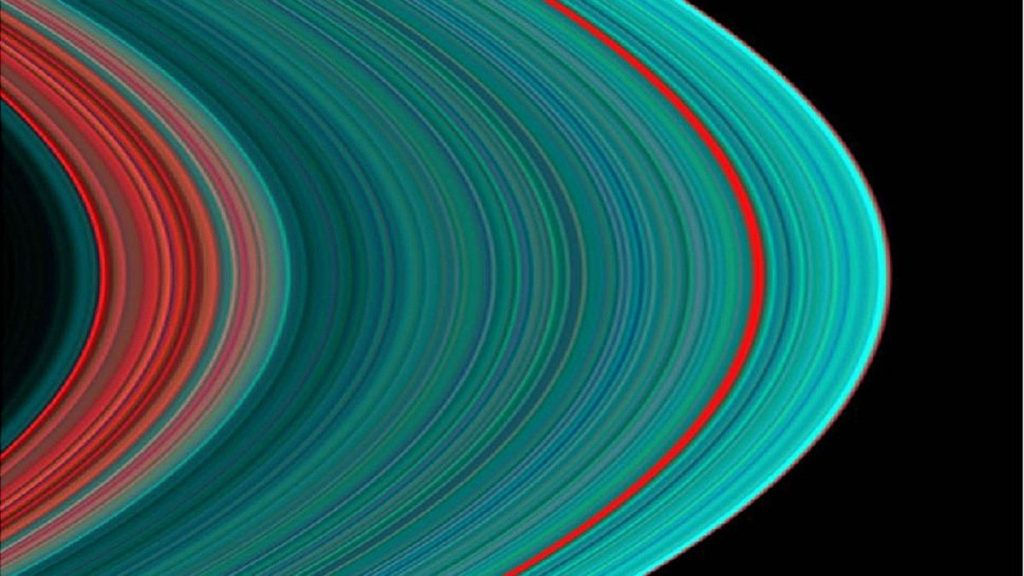
- The composition and dynamics of Saturn’s rings
- The atmospheres of moons such as Titan
- The plumes erupting from Enceladus
One major discovery was that the plume emerging from Enceladus’ south pole is composed primarily of water vapor, confirming the presence of subsurface water reservoirs.
The instrument also detected various gases throughout the Saturn system, including:
- methane
- hydrogen
- oxygen
- acetylene
- ethane
Observing Invisible Worlds
Because ultraviolet light is invisible to humans, scientists used UVIS measurements to reconstruct images that reveal processes otherwise hidden from traditional cameras.
According to Amanda Hendrix, a planetary scientist and UVIS team member:
“The cool thing about UVIS is that we can see things that are invisible to other instruments.”
For example, UVIS could observe gases that Cassini’s visible-light cameras could not detect and even study the dark night sides of Saturn’s moons, which appear bright in ultraviolet wavelengths.
Occultation Measurements
Another powerful technique used by UVIS was stellar and solar occultation. As Cassini moved through space, the instrument could observe how light from distant stars or the Sun changed as it passed through Saturn’s rings or atmospheres.
These subtle changes allowed scientists to measure the density, composition, and structure of the material the light passed through. Using this method, the UVIS team mapped ring structures up to ten times smaller than those visible to Cassini’s conventional cameras.
Expanding Our Understanding of the Saturn System
Through its ultraviolet observations, UVIS provided unprecedented insight into the complex environment surrounding Saturn. By revealing hidden gases, atmospheric processes, and ring structures, the instrument significantly advanced our understanding of planetary systems.
Its ability to observe phenomena invisible to other instruments made UVIS one of the most valuable scientific payloads aboard the Cassini spacecraft, contributing to many of the mission’s most important discoveries.