Camera blur behaviour in Space Systems
- January 24, 2026
- CAVU Aerospace UK
The CubeSat cameras are usually designed as a high-resolution imaging payload for LEO satellites, with its optics focused at infinity to capture targets on the Earth’s surface from orbital altitudes (~500 km). It uses a 60 mm aperture and an estimated 328 mm focal length, with a field of view of ±2.1°.
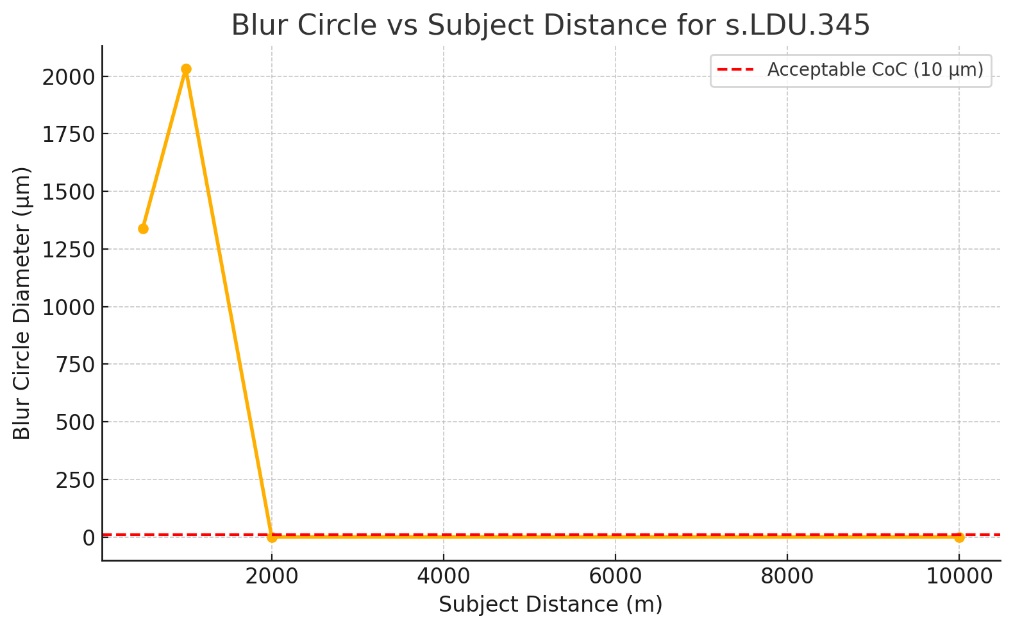
So the hyperfocal Distance ≈ 2 km and objects closer than 2 km will appear out of focus. The blur at 1 km is over 2 mm, which significantly exceeds the acceptable limit of ~10 µm, resulting in soft or blurred images.
Blur vs. Distance Plot
Below is a visualization of how the blur circle (in µm) changes with subject distance Red dashed line shows the acceptable blur limit (10 µm):
Optical parameters are:
- Effective focal length (EFL),
- Clear aperture,
- f-number,
- Pixel pitch,
We use a Circle of Confusion (CoC) criterion to define acceptable defocus.
CoC is not a physical property of the lens—it is a tolerance chosen based on sensor sampling and acceptable image degradation.
For this system:
- A reasonable value is
- A more conservative choice would be
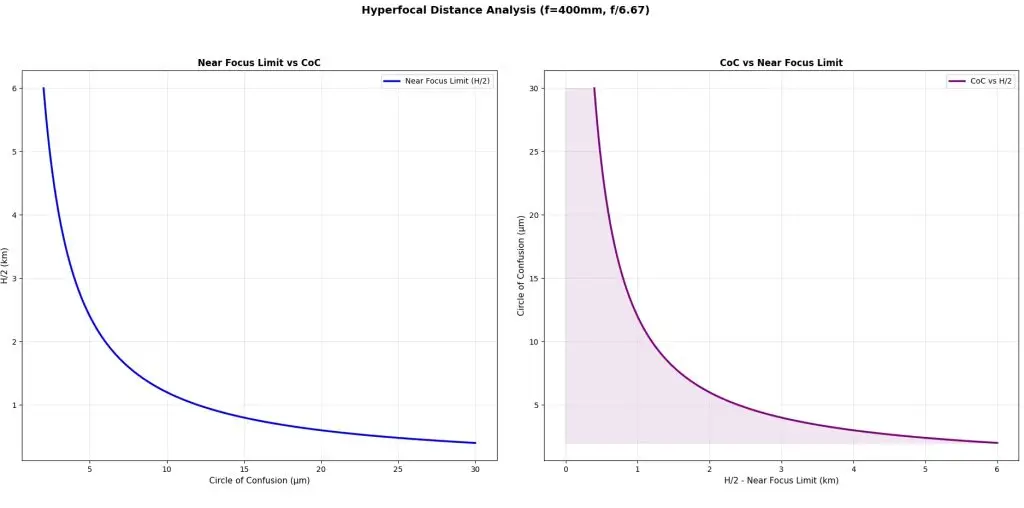
To estimate the minimum acceptable focus distance, we use the hyperfocal distance relation: H= F2 / Nc
When the system is focused at the hyperfocal distance , everything from approximately to infinity is considered “acceptably sharp” per the chosen CoC criterion.
With , this gives:
You can also use the same formula to plot versus CoC and directly see how the minimum focus distance scales with the blur tolerance.
For more details, get in touch to get Python script generating plots.