Asteroid Psyche, Next Cool in Deep-Space Exploration
Credit: NASA
- May 28, 2026
- CAVU Aerospace UK
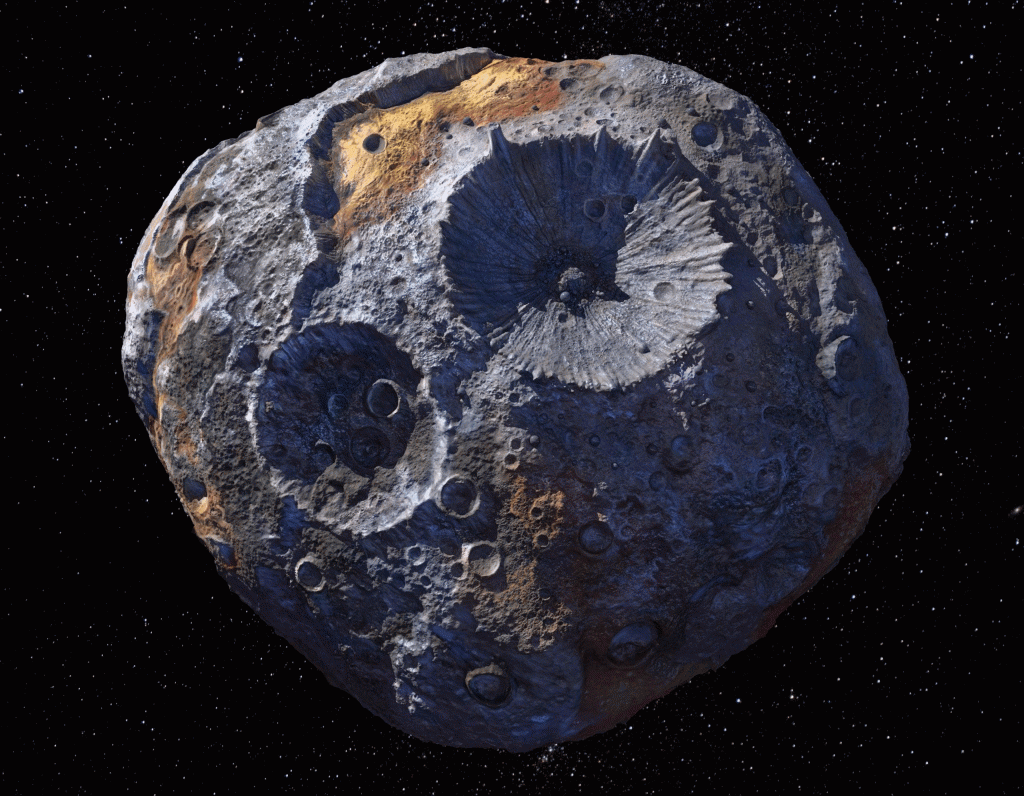
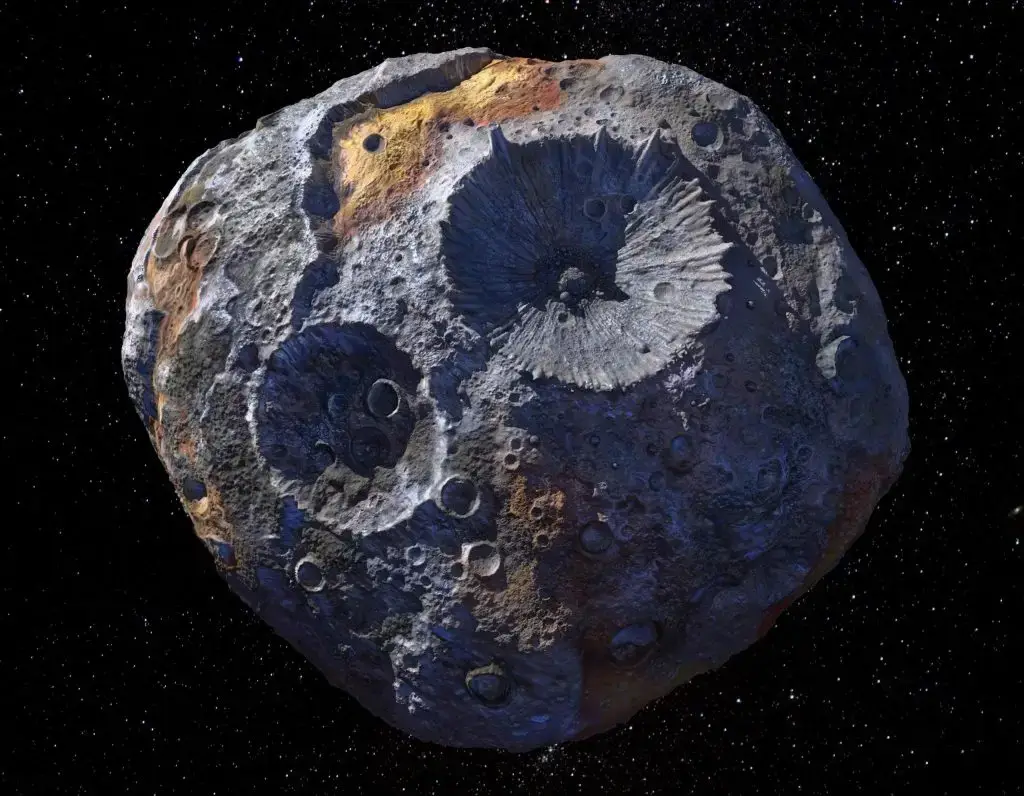
Among the countless asteroids orbiting in asteroid belt between Mars and Jupiter, few have captured scientific attention like 16 Psyche & we have hundreds of reasons for that. Unlike most asteroids, which are composed primarily of rock or ice, Psyche appears to contain unusually high concentrations of metal — especially iron and nickel. Scientists believe it may represent the exposed core of an early planetesimal, offering humanity a rare opportunity to study the inner structure of worlds similar to Earth without drilling through a planet’s crust.
The asteroid itself is enormous. It measures roughly 250 kilometers across and orbits the Sun in the main asteroid belt. Earlier observations suggested Psyche might be almost entirely metallic, but newer research indicates it is likely a complex mixture of metal and silicate rock. Current estimates suggest metals may account for between 30% and 60% of its volume.
Planetary scientists see Psyche as a time capsule from the early solar system. Around 4.5 billion years ago, young planetary bodies collided violently as planets formed. Some researchers believe Psyche may once have been part of a protoplanet whose rocky outer layers were stripped away during ancient collisions, exposing its metallic core. If true, the asteroid could reveal how rocky planets — including Earth — developed layered interiors consisting of crust, mantle, and core.
Recent studies also suggest Psyche’s surface is surprisingly diverse rather than uniformly metallic. Observations from telescopes and radio imaging show regions with varying thermal properties and mineral compositions. Some areas appear richer in metals, while others contain fine silicate dust or impact-delivered material from other asteroids.
Psyche Mission
To investigate this mysterious object, NASA launched the Psyche mission on October 2023. The spacecraft was sent aboard a Falcon Heavy rocket. It has gravity assisted trajectory & expected to arrive at the asteroid in 2029.
The spacecraft uses solar-electric ion propulsion, an efficient technology that slowly accelerates spacecraft over long periods using electrically charged xenon ions. This system allows the mission to travel more than 2.2 billion miles while conserving fuel.
Once in orbit around Psyche, the spacecraft will spend approximately 26 months studying the asteroid using several scientific instruments:
- A multispectral imager for detailed surface mapping
- A gamma-ray and neutron spectrometer to determine chemical composition
- A magnetometer to detect ancient magnetic fields
- A gravity science experiment using radio tracking to reveal internal structure
The mission also carries an experimental laser communication system known as Deep Space Optical Communications, which aims to transmit data much faster than traditional radio systems.
The Psyche mission recently achieved one of its most important milestones: a close flyby of Mars on May 15, 2026. During the maneuver, the spacecraft passed within about 2,864 miles of Mars. The flyby acted as a gravity assist, increasing the spacecraft’s speed by roughly 1,000 mph and adjusting its orbital path toward the asteroid.
Hanging spacecraft is devil’s playground, so it has to be some cool jobs to pick up while travelling to Psyche. During the encounter with Mars, Psyche captured spectacular images of Mars, including views of the south polar ice cap, heavily cratered terrain, and a glowing crescent-shaped atmosphere. These images helped engineers calibrate the spacecraft’s instruments before arrival at the asteroid.
Media headlines often describe Psyche as “the trillion-dollar asteroid” because of its estimated metal content. While the asteroid likely contains enormous quantities of iron and nickel, mining it is far beyond current technological and economic capability. Scientists emphasize that the mission’s true importance is scientific, not commercial. The goal is to understand how planets form and evolve — knowledge that could fundamentally change planetary science.
If all continues according to plan, NASA’s Psyche spacecraft will arrive at the asteroid in summer 2029 and begin orbit operations shortly afterward. Over the following two years, humanity may receive its first close-up look at what could be the exposed heart of a failed world from the dawn of the solar system.
The Psyche mission represents more than an asteroid exploration project. It is an attempt to look beneath the surface of rocky planets and uncover the hidden processes that shaped Earth and its neighbours billions of years ago.