
Asset Management in Space Flight Hardware: Maximising the Value of Every Engineering Unit
- September 28, 2026
- CAVU Aerospace UK
A conventional spacecraft development programme may call for an Engineering Model (EM), Qualification Model (QM), Flight Model (FM), and sometimes one or more flight spares. For a complex spacecraft, this can mean that a customer pays for several almost-identical pieces of hardware before a single unit ever reaches orbit.
There are good engineering reasons for this approach. Engineering models provide a platform for software and interface development. Qualification models demonstrate that the design can survive the required environmental conditions. Flight models are manufactured and verified for the actual mission. However, there is another question that should be asked much earlier:
Can the same hardware create value at more than one stage of the programme—or even become a different product altogether? This is the foundation of effective asset management in space flight hardware. At CAVU Aerospace, we believe the objective should not simply be to minimise the number of units manufactured. The objective should be to maximise the engineering value generated by every unit the customer pays for.
The traditional EM–QM–FM approach
A simplified conventional development flow might look like:
Engineering Model → Qualification Model → Flight Model → Flight Spare
Each unit has a specific role. The Engineering Model is typically used for software development; firmware development; interface testing; spacecraft integration; performance testing & customer training. The Qualification Model is normally used to demonstrate that the design can withstand the environmental conditions expected during the mission, potentially including vibration, shock, thermal-vacuum and other mission-specific tests.
The Flight Model is then manufactured and subjected to the appropriate acceptance and verification programme before entering service. This approach is technically sound. But it can also create significant duplication.
A customer could potentially purchase 1 × EM, 1 × QM, 2 × FM, 1 × flight spare
That is five sophisticated pieces of hardware, while only two may ultimately perform the mission. The additional hardware may be entirely justified. The problem is when the hardware lifecycle is not considered from the beginning. The question should therefore change from: “How many models do we need?” to: “What is the most valuable lifecycle for each asset?”
The greatest opportunity for cost optimisation often exists before procurement begins. This changes the philosophy from hardware procurement to hardware lifecycle management.
There are actually several levels of hardware reuse.
- Level 1 — Reuse the physical unit
- Level 2 — Reuse the unit as a ground asset
- Level 3 — Reuse the hardware platform
- Level 4 — Reuse the design heritage
The same PCB and core electronics are used in different product configurations. For example:
- Common OBC Base Board → OBC-Hyper-Polar
- Common OBC Base Board → Typhoon-Edge
- Common OBC Base Board → Other mission-specific configurations
The peripheral architecture changes, but the core computing platform remains substantially common. Even when a new physical unit must be manufactured, the engineering investment is reused. This can be extremely valuable because the most expensive part of a space computer is not necessarily the physical PCB—it is the engineering knowledge behind it.
CAVU’s approach: one OBC platform, multiple products
A good example of this philosophy is CAVU Aerospace’s approach to its OBC platforms. The OBC-Hyper-Polar, Typhoon-Edge and other configurations can share a common OBC base-board architecture while being adapted for different mission requirements through their peripheral and system-level configurations. Instead of designing a completely new computer for every application, the core OBC platform can be treated as a reusable engineering asset.
The customer therefore benefits from the development work being distributed across multiple configurations. A simplified architecture can be viewed as:
Common OBC Base Board
↓
Different peripheral / interface architecture
↓
Different product configuration
↓
Different spacecraft application
For example:
- OBC Base Board + mission-specific peripherals → OBC-Hyper-Polar
- OBC Base Board + high-performance edge-computing architecture → Typhoon-Edge
- OBC Base Board + other mission-specific interfaces → other CAVU configurations
This approach means that the engineering work invested in the base computer does not belong to only one product. It becomes a platform asset. This is particularly powerful during development. Imagine that the first application requires a particular OBC configuration. The customer funds engineering development, PCB design, firmware, BSP development, testing and integration. Once that work is complete, it would be inefficient to treat all of that engineering effort as belonging exclusively to the first product. Instead, the same base architecture can become the starting point for another configuration.
The second product may require additional interfaces; networking; mechanical packaging; additional FPGA functionality; high-performance AI processing or different peripheral boards. But the core OBC can remain common. This means that the second configuration does not necessarily begin at zero engineering maturity. It begins with an existing platform.
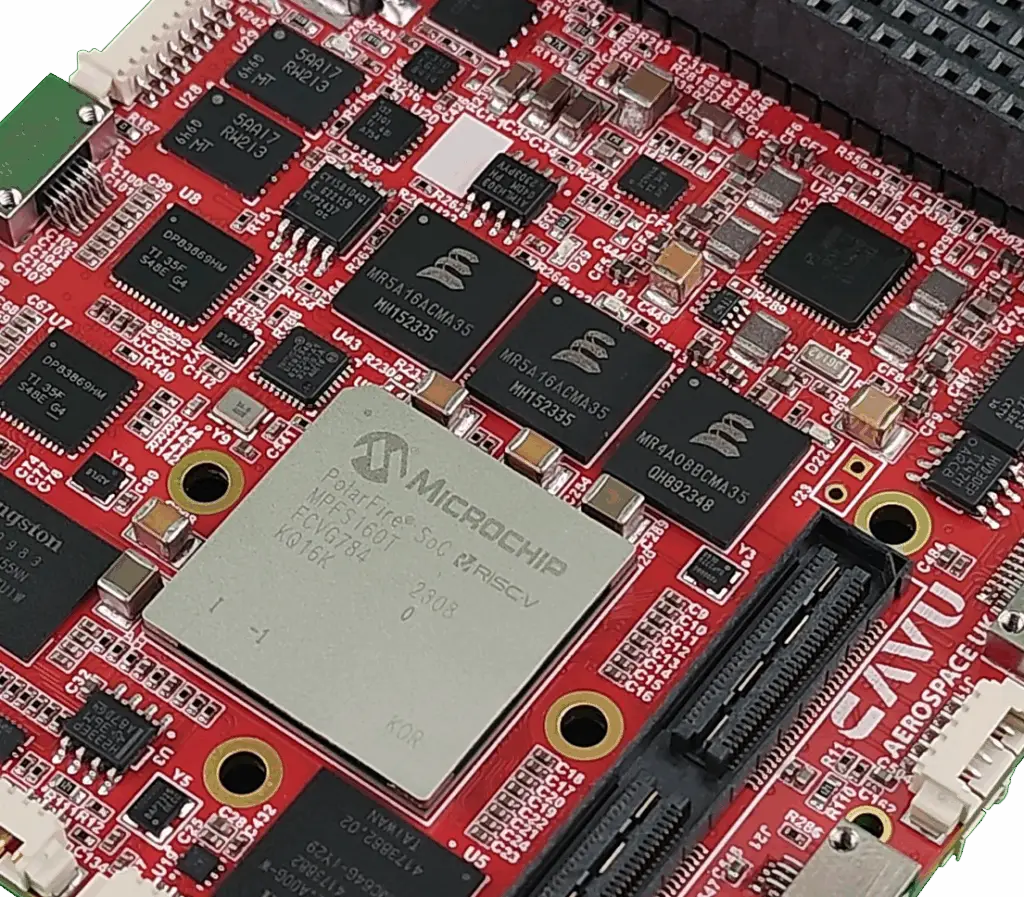
OBC-Hyper-Polar: a platform rather than a single product
OBC-Hyper-Polar is a good example of this approach. The OBC can provide a common computing foundation while different system-level configurations provide different capabilities. For one application, the computer may be integrated with particular I/O, storage, communication or control peripherals. For another, the same underlying OBC architecture can be integrated with a different peripheral set.
The result is effectively:
One core hardware investment → multiple system configurations.
This is fundamentally different from designing every spacecraft computer as a completely independent product. The customer is not simply purchasing an individual board. They are benefiting from a hardware platform with multiple possible configurations.
Typhoon-Edge: edge computing
The same concept can be extended into more demanding applications such as CAVU’s Typhoon-Edge architecture. Instead of treating the OBC and high-performance processing system as completely unrelated developments, a common OBC platform can provide the spacecraft control, supervision and interface foundation while the edge-computing architecture adds the processing capability required by the application. This is particularly relevant for applications such as:
- on-orbit servicing;
- robotic systems;
- machine vision;
- autonomous operations;
- high-speed image processing;
- spacecraft inspection;
- robotic-arm control.
The customer can therefore obtain a specialised system without necessarily requiring an entirely new spacecraft computer architecture.One of the reasons platform reuse works particularly well for spacecraft electronics is that the processor is only one part of the system.
A spacecraft computer may contain:
- processor/SoC;
- FPGA;
- memory;
- storage;
- power conditioning;
- SpaceWire;
- Ethernet;
- CAN;
- RS422;
- RS232;
- GPIO;
- ADC/DAC;
- timing;
- watchdogs;
- FDIR;
- radiation mitigation;
- software and BSP.
Different missions may need different combinations. A platform architecture allows the core functionality to remain stable while the system is adapted around it. This creates a kind of building-block approach to spacecraft electronics. Instead of:
New spacecraft → new OBC → new PCB → new software → new verification
the philosophy becomes:
New spacecraft → established OBC platform → appropriate configuration → targeted additional development.
Reuse is not only about saving money. It can reduce technical risk. When the same architecture is used repeatedly, the engineering team gains experience with component behaviour; PCB manufacturing; thermal performance; EMC behaviour; firmware; drivers; boot processes; FDIR; software interfaces; manufacturing processes & environmental testing.
Problems discovered in one configuration can improve subsequent configurations. The result is a feedback loop below. This is one of the major benefits of productisation in the space industry.
Mission A → Engineering Knowledge → Platform Improvement → Mission B → More Knowledge → Improved Platform
NASA and the value of duplicate hardware
NASA provides a useful example of another aspect of asset management. The Hubble Space Telescope’s Vehicle Electrical System Testbed was created as a ground-based environment for reproducing Hubble’s electrical and operational behaviour. NASA describes the VEST as containing a mechanical and electrical engineering model of Hubble’s central structure, together with spaceflight-qualified spare modules and engineering duplicates of spacecraft hardware. The purpose was not simply to have another telescope. The ground hardware provided an invaluable platform for testing and troubleshooting without experimenting directly on the spacecraft in orbit. This illustrates a critical principle:
A duplicate piece of hardware can be extremely valuable when it provides a capability that the flight asset cannot safely provide. A spacecraft computer on the ground can be used for testing a software update. The spacecraft computer in orbit cannot necessarily be used for the same purpose. The ground unit therefore has a different—and potentially very significant—value.
There is also a fascinating example involving the Magdalena Ridge Observatory. The observatory’s 2.4 m telescope uses a primary mirror produced during the competition for the Hubble mirror contract. The mirror subsequently became available after its earlier programme and ultimately found a new application at Magdalena Ridge. This is not an example of a duplicate Hubble Space Telescope. It is, however, an excellent illustration of a broader aerospace principle: High-value hardware can retain significant value after its original programme has ended. The same principle applies to spacecraft electronics.