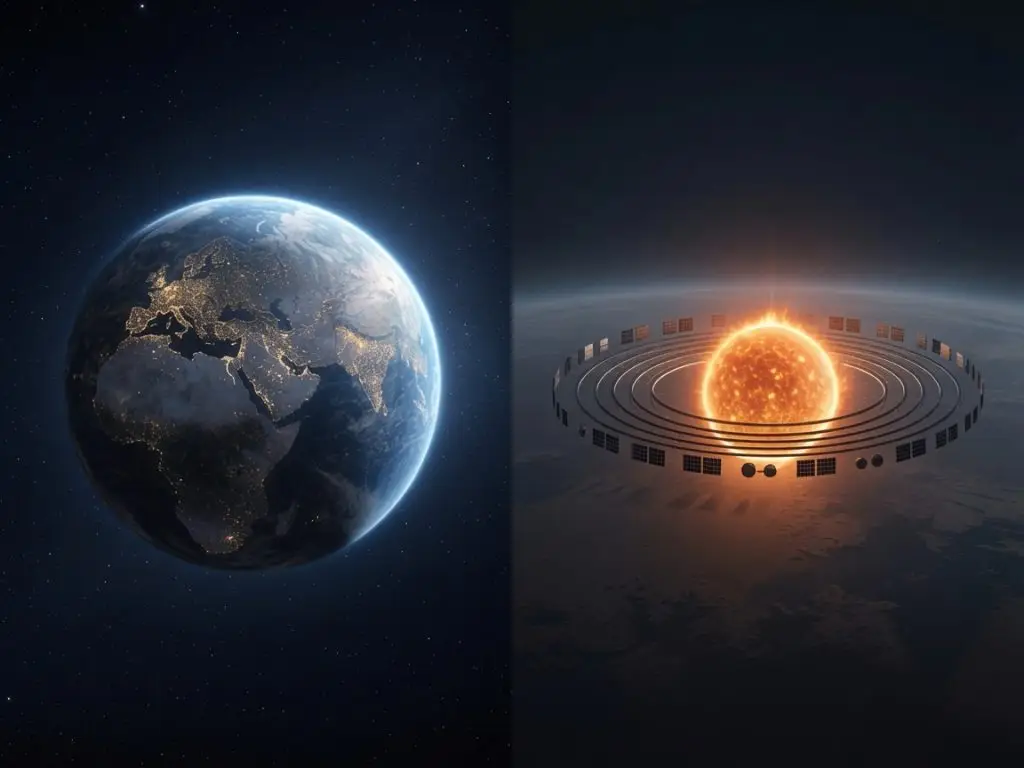
AI Satellites, Space-Based Solar Power, and the Path to a Kardashev Type II Civilization
- June 19, 2026
- CAVU Aerospace UK
As artificial intelligence advances and global energy demand continues to grow, humanity faces a fundamental challenge: how do we generate enough clean, reliable energy to support the next stage of civilization?
One of the most compelling frameworks for understanding this challenge is the Kardashev Scale, developed by Soviet astronomer Nikolai Kardashev in 1964. The scale measures a civilization’s technological advancement based on the amount of energy it can harness and utilize.
- Type I Civilization: Harnesses all energy available on its home planet (~10¹⁶–10¹⁷ watts).
- Type II Civilization: Harnesses the energy output of its parent star (~3.8 × 10²⁶ watts for the Sun).
- Type III Civilization: Harnesses the energy output of an entire galaxy.
Humanity is currently estimated to be around Kardashev 0.73, meaning we are still far from fully utilizing even the energy resources available on Earth.
To move up the Kardashev Scale, civilization must dramatically increase its access to energy. Artificial intelligence, autonomous satellite networks, and space-based solar power may provide the technological pathway to achieve this goal.
The Energy Challenge of the AI Age
Artificial intelligence is rapidly becoming one of the largest consumers of electricity.
Training frontier AI models requires enormous computational resources, while future AI systems, robotics networks, autonomous factories, and digital infrastructure could require power on a scale never before seen.
Global energy consumption today is approximately 20 terawatts (TW), However, a true Type I civilization may require 100–1,000 terawatts of sustained power generation.
The question is no longer whether humanity can produce renewable energy. The question is whether Earth alone can provide enough energy for future technological growth.
Solar power on Earth is already one of the fastest-growing energy sources, but it suffers from several unavoidable limitations:
- Night-time darkness
- Cloud cover
- Atmospheric absorption
- Seasonal variation
- Land-use constraints
A solar panel in orbit faces none of these challenges.
At Earth’s distance from the Sun, the solar constant is approximately: 1,361 watts per square metre, Unlike ground-based systems, orbital solar arrays can receive sunlight almost continuously.
A satellite in geostationary orbit can remain illuminated for approximately 99% of the year, interrupted only briefly around the equinoxes. This means space-based solar power systems could achieve capacity factors exceeding 90–95%, compared with 15–30% for many terrestrial solar installations. As a result, the same solar collection area in space can produce several times more electricity annually than an equivalent installation on Earth.
The Starship Game Changer in Cost of Access to Space
For decades, space-based solar power was considered technically possible but economically unrealistic. The main obstacle was launch cost. Historically, placing payloads into orbit often cost more than $10,000–20,000 per kilogram. Building gigawatt-scale solar power stations in orbit would have required thousands of tonnes of hardware, making launch expenses prohibitively high. Today, that situation is changing rapidly.
The development of fully reusable heavy-lift launch vehicles, especially SpaceX’s Starship, represents one of the most important developments in the history of space infrastructure.
Starship is designed to transport more than 100 tonnes of payload into orbit while being rapidly reusable. If successful, it could reduce launch costs by an order of magnitude or more compared with traditional rockets. Industry projections suggest future launch costs could eventually fall below $100 per kilogram, Although the final economics remain uncertain, the trend is clear: access to space is becoming dramatically cheaper.
This shift fundamentally changes the feasibility of large-scale orbital infrastructure. A concept that seemed economically impossible ten years ago may become practical within the next two decades. The combination of reusable launch systems, advanced robotics, and AI-driven operations is making humanity’s first orbital energy economy increasingly realistic.
AI as the Operating System of Orbital Infrastructure
Constructing and operating thousands—or eventually millions—of satellites cannot realistically be achieved through human operators alone.
Artificial intelligence will likely become the management layer of future space infrastructure.
AI systems could:
- Coordinate satellite constellations
- Optimize power generation
- Manage wireless energy transmission
- Predict hardware failures
- Schedule maintenance activities
- Control autonomous repair robots
- Balance energy distribution globally
Instead of individual spacecraft, future orbital energy systems may function as vast autonomous networks operating with minimal human intervention.
The real breakthrough may occur when AI combines with robotic manufacturing.
Future satellites could:
- Detect degradation automatically
- Manufacture replacement components
- Perform robotic repairs
- Harvest resources from asteroids
- Construct additional solar collectors
Such systems could eventually become partially self-sustaining. Every new solar satellite would generate additional energy, which could support more AI computation and more manufacturing capability.
This creates a powerful feedback loop:
- More solar collectors generate more energy.
- More energy powers larger AI systems.
- Larger AI systems manage more infrastructure.
- More infrastructure captures more solar energy.
This positive feedback cycle could enable exponential expansion of humanity’s energy-harvesting capability.
One of the most overlooked advantages of orbital infrastructure is thermal management.
On Earth, cooling consumes a significant fraction of data-centre energy.
Large AI data centres can require enormous cooling systems involving:
- Air conditioning
- Water cooling
- Cooling towers
- Pumps and heat exchangers
Cooling can account for 20–40% of a facility’s total energy consumption.
In space, waste heat can be radiated directly into deep space using large radiator panels.
The cosmic microwave background temperature is approximately 2.7 Kelvin (-270°C) Although heat transfer in vacuum relies on radiation rather than convection, large radiator surfaces can continuously reject thermal energy without consuming water or requiring atmospheric cooling systems.
Future orbital AI data centres could therefore achieve substantially lower cooling overheads than equivalent Earth-based facilities. This becomes increasingly important as AI computation scales upward.
Building Toward a Kardashev Type II Civilization
Humanity currently consumes approximately 20 terawatts of power. To reach the lower end of Type I civilization estimates, humanity may need access to around 100 terawatts or more.
Consider a future network consisting of 10,000 orbital solar power satellites, each generating 1 gigawatt, Total output: 10 terawatts, A constellation of 100,000 satellites each generating 1 gigawatt would produce 100 terawatts. This approaches the energy levels often associated with a true planetary civilization. Importantly, the energy resource itself is virtually unlimited. The Sun continuously delivers approximately 174,000 terawatts to Earth. Human civilization currently uses only a tiny fraction of that amount.