
18 Sensors, 300 million Pixels: Inside NASA Youngest Science Fleet, Roman Telescope
Credit: NASA
- September 19, 2026
- CAVU Aerospace UK
The next generation of space astronomy is not only about bigger mirrors. It is also about building enormous, extremely sensitive imaging systems capable of capturing vast regions of the universe in a single observation.
At the heart of NASA’s Nancy Grace Roman Space Telescope is exactly such a system: the Wide Field Instrument, a 300-megapixel camera designed to survey enormous areas of the sky while maintaining image quality comparable to the Hubble Space Telescope. Unlike a conventional camera that uses one large sensor, Roman’s WFI creates its huge focal plane by combining 18 individual infrared detectors into a precisely aligned detector mosaic.
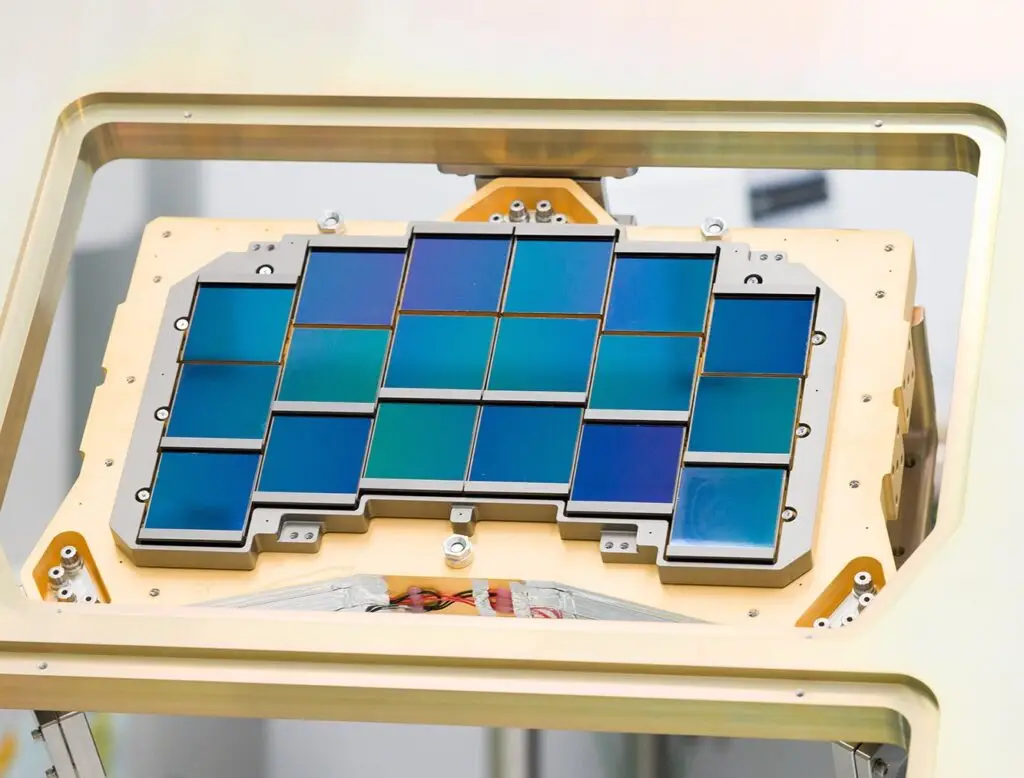
The WFI is Roman’s primary science instrument. It is both a wide-field imaging camera and a slitless spectrometer, operating from approximately 0.48 to 2.3 micrometres, covering visible red light through the near-infrared.
Its principal characteristics are impressive, 18 image sensors, each 4096 × 4096 pixels in × 10 µm size. Totally makes 302 million pixels in 0.8° × 0.4° field of view.
The detector itself does not simply record a conventional RGB image. Before the light reaches the detectors, it passes through Roman’s Element Wheel Assembly, which contains different optical elements. The WFI has eight imaging filters, covering wavelengths from approximately 0.48 to 2.3 µm.
Each filter allows scientists to study astronomical objects in a different wavelength band. The instrument also includes a prism and a grism for slitless spectroscopy. Instead of simply producing an image, these elements spread the light from astronomical objects according to wavelength, allowing scientists to obtain spectral information across the entire field.
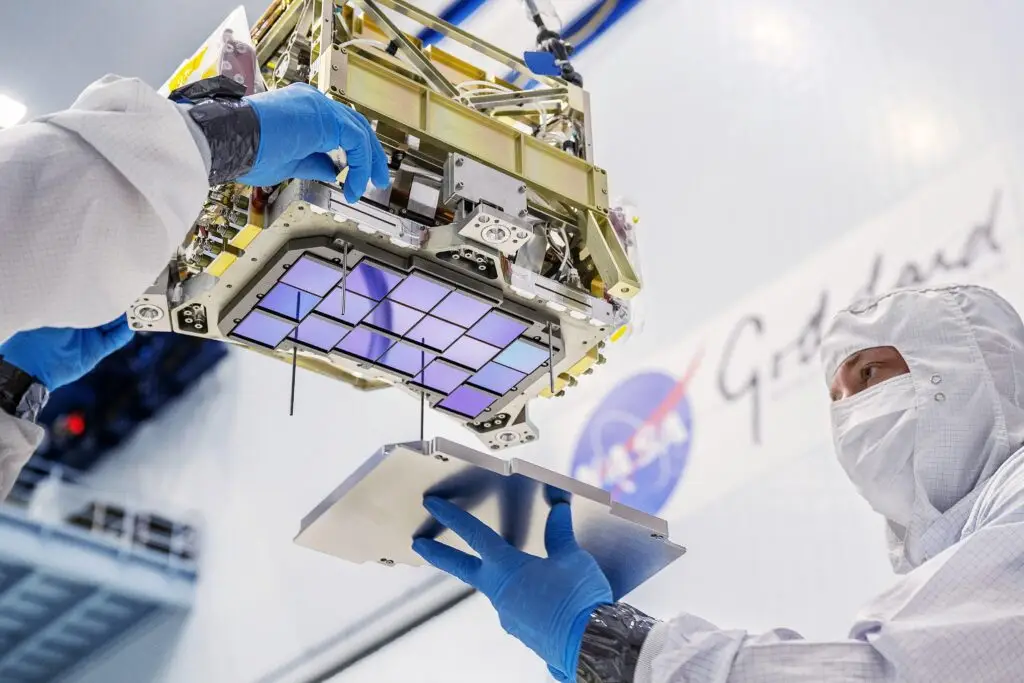
Building a 300-megapixel camera for space is not simply a matter of connecting 18 sensors together. The detectors have to operate as a single precision optical and electronic system. The 18 detectors are mounted on a rigid focal-plane structure, with an Alignment Compensation Mechanism providing fine adjustment of the focal plane. The mechanism can control the detector assembly in six degrees of freedom to optimize alignment and focus. This is where the Roman camera becomes particularly interesting from an engineering perspective: 300 million pixels are only useful if the spacecraft can maintain the mechanical, thermal, optical and electronic conditions necessary to exploit them.
The real innovation of Roman is not simply that it has more pixels than Hubble. It is the combination of 2.4-metre telescope + wide-field optics + 18 large-format HgCdTe detectors + 10-µm pixels + near-infrared sensitivity + precision spacecraft stability. Roman is designed to conduct enormous surveys investigating some of the biggest questions in modern astrophysics, including dark energy, dark matter, galaxy evolution and exoplanets. And that makes the focal plane shown in your photograph particularly significant. Those 18 blue tiles are effectively the “eyes” of Roman. Each one contains more than 16 million individual light-sensitive pixels. Together, they create a 300-megapixel space camera capable of imaging an area of the sky roughly the size of the full Moon in a single pointing—while retaining a level of spatial detail comparable to Hubble’s infrared imaging.
Here is a general comparison in NASA science fleet which is making biggest role in expanding understanding of human:
Hubble WFC3/IR | Webb NIR Cam | Roman WFI | |
Detector format | ~1k × 1k | 2k × 2k | 4k × 4k |
Detector technology | HgCdTe | HgCdTe | HgCdTe |
Pixel pitch | 18 µm | 18 µm | 10 µm |
Number of detectors* | 1 | Multiple | 18 |
Roman WFI total | — | — | ~300 MP |
Wavelength coverage | NIR | NIR | 0.48–2.3 µm |
Wide-field emphasis | Moderate | Moderate | Very high |