
Radiation Tolerance Is a System Property — Not Just a Component Choice
By: Amir Azadi
- November 14, 2026
- CAVU Aerospace UK
Recently, we had the pleasure of welcoming Sandi Habinc, General Manager at FrontgradeGaisler, to our CAVU AEROSPACE UK R&D office in Stirling. We had a long discussion about space processing architectures, fault tolerance, and how the technology has evolved—from LEON3 on ProASIC3 with explicit Triple Modular Redundancy (TMR) to modern RISC-V processors integrated with large flash-based FPGA fabrics.
The technology has changed dramatically, but the physics has not. This creates a misconception that I still see quite often:
A flash-based FPGA does not automatically make a processing board radiation-tolerant. I have written before about why putting a microcontroller on a PCB does not automatically make it a satellite OBC. The same principle applies here. Putting a flash-based FPGA on an SBC does not suddenly make that SBC space-qualified, radiation-tolerant, or necessarily space-worthy.
⚠️ Configuration memory is only one part of the problem
One major advantage of flash-based FPGAs is their non-volatile configuration and, in the relevant device families, resistance to the radiation-induced configuration upsets that can affect SRAM-based FPGAs. That is a major advantage in space.
However, resistance to configuration upsets is not a blanket guarantee against other single-event effects or accumulated total ionising dose. The exact device—and its radiation-characterisation data—still matters.
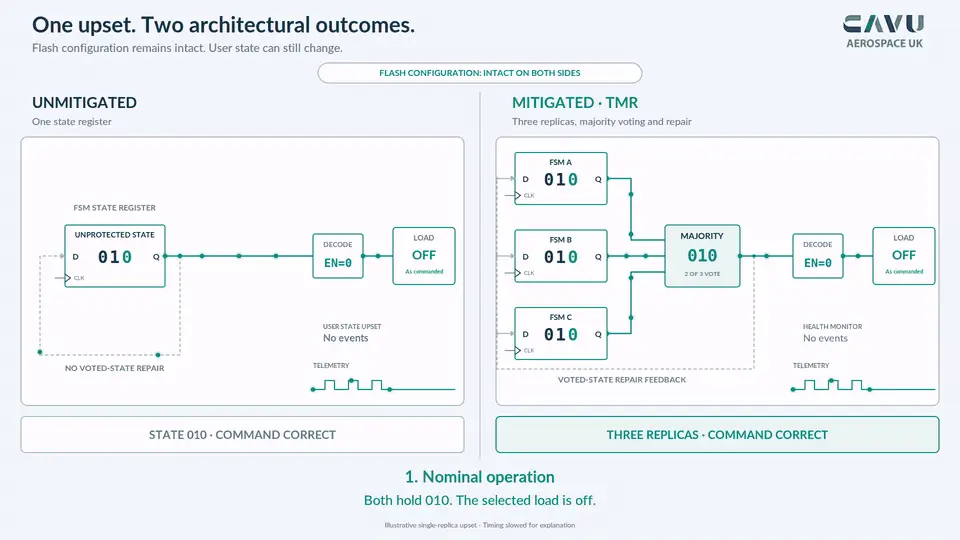
The user design inside the FPGA still contains flip-flops, counters, state machines, block RAM, FIFOs, datapaths, clocks, resets, control registers, address generators, and interface logic. The configuration may remain perfectly intact while the state of the running system becomes corrupted. That distinction is critical.
⚡ Not every upset has the same consequence
An error in one image-processing pixel may be irrelevant; an error in a motor-enable signal may not be. A corrupted accumulator might affect one calculation, while a corrupted address pointer could overwrite memory. A flipped state-machine bit could put a controller into an unsafe state.
So mitigation should not begin with “How much TMR should we implement?” It should begin with:
“What happens to the spacecraft if this particular state is corrupted?”
That is the more important engineering question.
🛡️ TMR is important, but it is not everything
TMR is one of the best-known FPGA mitigation techniques, but proper TMR involves much more than triplicating some registers. You still need to consider where the voters are placed, whether the voter itself becomes a single point of failure, whether the replicas share an unprotected clock, reset, or enable path, whether an upset can remain latent inside one replica, and whether feedback voting is required to repair corrupted state.
A design can contain a lot of TMR and still have a vulnerable common clock-enable or reset signal.
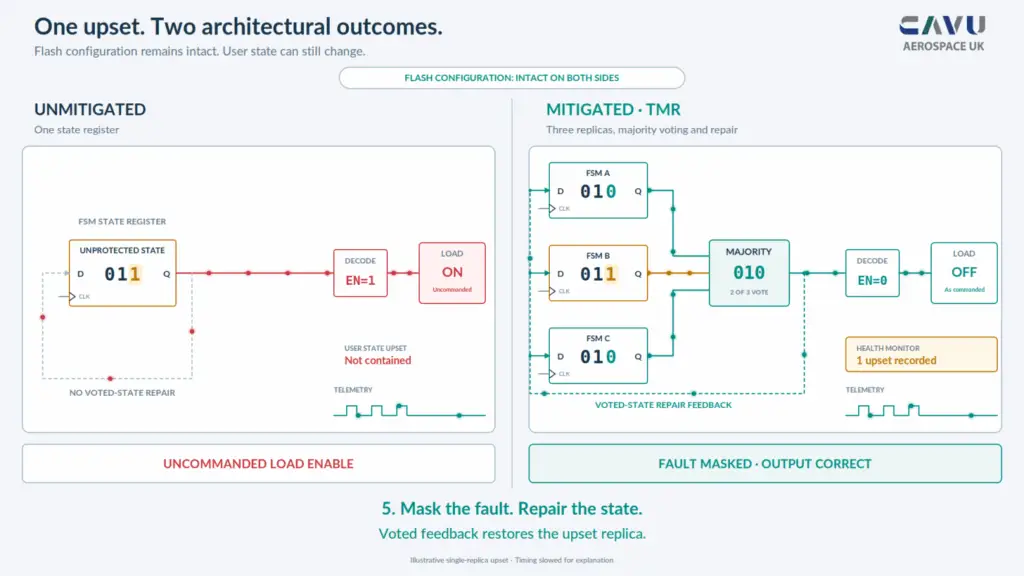
Good TMR is an architecture, not simply a synthesis option.
💾 Memories and state machines need their own strategy
Flash-based FPGAs can still contain volatile embedded SRAM used for buffers, FIFOs, processor memories, lookup tables, telemetry, and intermediate processing. Depending on the mission and the device, these memories may require ECC/EDAC, scrubbing, duplication, CRC protection, or recovery mechanisms.
The same principle applies to external DDR, SRAM, MRAM, NAND, or eMMC: each memory technology and device needs its own assessment and protection strategy. Using a radiation-tolerant FPGA does not automatically protect the memory connected to it.
State machines deserve particular attention as well. A large DSP datapath may tolerate an occasional corrupted sample, while a tiny FSM controlling power, propulsion, or deployment can become mission-critical. For these functions, combinations of TMR, safe-state encoding, illegal-state detection, watchdogs, and deterministic recovery may be required.
⏱️ Clocks and resets are often the hidden single point of failure
You can triplicate an entire processing chain, but if all three copies depend on one vulnerable clock-enable or reset path, a common-mode fault can still defeat the redundancy.
Clock distribution, reset generation, watchdog control, global enables, and power-good signals can sometimes matter more than the main datapath. Fault tolerance is only as strong as the remaining single points of failure.
See content credentials
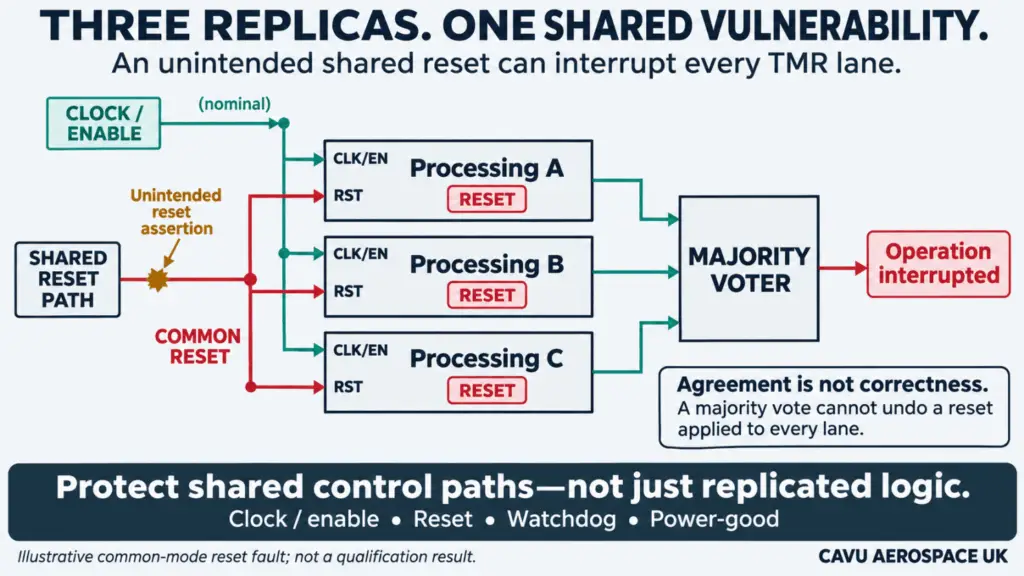
One shared reset fault can interrupt all three replicas. Majority voting does not remove common-mode vulnerabilities in the control infrastructure.
🧩 Some FPGAs do more of the work in hardware
There is an important distinction between a commercial flash FPGA and a device specifically designed for radiation environments. Microchip’s RTG4 family, for example, provides SEU-hardened registers, embedded SRAM blocks with built-in EDAC capability, and hardened global clock and reset resources.
Those features reduce the mitigation burden on the designer, but the device’s operating conditions, configuration requirements, and limitations still need to be understood. Even then, the FPGA is only one part of the system.
Power, external memories, interfaces, software, watchdogs, resets, and fault containment still have to be engineered properly. The same applies to modern RISC-V-based FPGA SoCs. We now have much more processing performance, more memory, and more interfaces than we had in the LEON3 generation—but also many more states and potential failure modes to consider.
The processor architecture may have changed, but the engineering philosophy has not: Understand the failure mechanisms, contain them, detect them, and recover from them.
🛰️ Radiation tolerance is a system property
For me, the key point is simple: Flash configuration does not equal a radiation-tolerant FPGA design. A radiation-characterised FPGA does not equal a radiation-tolerant board. A radiation-tolerant board does not automatically equal a fault-tolerant computer.
Space electronics cannot be reduced to selecting one impressive component. What matters is the architecture around it—and whether the system can continue operating when something eventually goes wrong. Because in space, the objective is not to assume that faults will never happen. It is to make sure that when they do, they do not become mission failures.