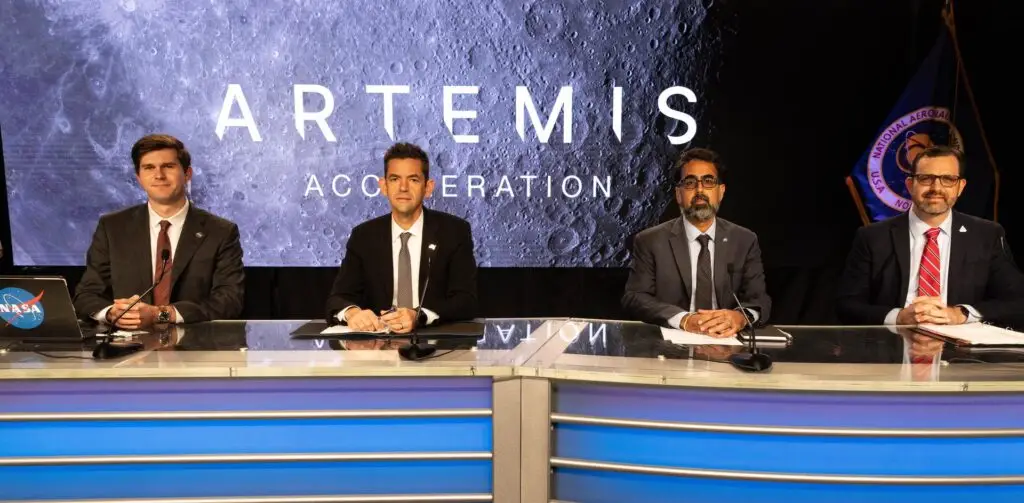
Lucky Artemis Generation: NASA Strong Demand Signal to the Space Industry — We Are NOT Slowing Down
Credit: NASA
- November 10, 2026
- CAVU Aerospace UK
On 23 October 2026, NASA Administrator Jared Isaacman delivered a message that deserves the attention of every engineer, technology company, and organisation working in the space industry: returning to the Moon is not simply a mission & this time is not just about flags & footprints. It is a commitment to build the capabilities, infrastructure, and industrial capacity required for a sustained human presence beyond Earth. NASA’s latest Artemis update reinforced its objective of returning astronauts to the lunar surface by 2028, while accelerating the development of the systems required to make that ambition possible. Artemis III is planned to test critical spacecraft and lander systems in Earth orbit in 2027, preparing the way for Artemis IV and a return to the lunar surface.
This is a demand signal. And the space industry needs to listen.
The significance of Artemis extends far beyond the launch of a rocket or the landing of astronauts. It represents a long-term demand for advanced engineering, reliable flight computers, autonomous systems, communications, power management, robotics, scientific instruments, thermal control, and technologies capable of operating in some of the harshest environments imaginable. Establishing a sustainable presence on the Moon requires much more than reaching its surface. It demands the ability to operate, maintain systems, conduct science, manage resources, and support increasingly complex missions over time.
The question is no longer simply whether we can build a spacecraft capable of completing one extraordinary mission. It is whether we can develop the technologies, manufacturing capacity, and supply chains to support an entire generation of exploration. For companies developing space-qualified hardware and advanced onboard computing, this is a particularly important signal. Demand for capability, reliability, processing power, autonomy, and increasingly sophisticated spacecraft systems will be central to the next era of exploration.
The Artemis generation
Apollo inspired a generation to become engineers, scientists, and explorers. Artemis has the potential to do the same — but with an important difference. The Artemis generation will not only witness humanity returning to the Moon, planting flags & collect rocks. It will help build the systems that allow humanity to stay there.
Artemis generation to build Moon base & then step an Earth born life into Mars! This is achievable if whole industry keep muscle memory of Moon base & try high-risk, fast-pace flight after flight. This means we should already be preparing vehicles for Artemis 10+ to be able to go fast. Just like Gemini & Artemis programs. In Artemis then gap between first crewed mission (Apollo 7) to first Moon landing at Apollo 11 was only 9 months! This is the goal for Artemis generation with greater access to technology, data & stronger than ever commercial partners!
Artemis generation has everything ready, even rivalry. NASA still is years ahead of second runner in new space race, but administrator present them as strong competitor to keep attention & funds in space program. New NASA leadership also has supported commercial space companies more than ever by sending strong demand signal, multiple RFIs in short period of time & keep attentions on space sector. Artemis generation is really building up!
This generation will develop spacecraft that can make more decisions autonomously, process scientific data closer to its source, coordinate complex robotic operations, and support missions where communication with Earth cannot always be immediate. It will bring together advances in artificial intelligence, radiation-tolerant computing, FPGA technology, high-performance processors, autonomous navigation, and intelligent sensing. These capabilities will be essential not only for lunar exploration, but also for future missions to Mars and beyond. The opportunity is therefore much larger than any individual mission. It is an opportunity to build an enduring technological foundation for humanity’s future in space.
A demand signal for the entire industry
Ambitious programmes need more than vision. They need suppliers who can deliver, engineering teams that can solve difficult problems, and manufacturers prepared to invest in capabilities before demand reaches its peak. NASA’s decision to accelerate Artemis sends a clear message to industry: readiness matters. Development speed matters. Reliability matters. And the ability to turn complex engineering into operational hardware matters.
For the supply chain, this means preparing now — developing products, qualifying technologies, strengthening production capabilities, and ensuring that critical components and systems are available when missions need them. It also creates an opportunity for innovative companies beyond the largest aerospace organisations. Specialist engineering businesses can contribute essential capabilities, from onboard computers and control electronics to intelligent payload processing and autonomous systems. The future of space exploration will depend on collaboration across the entire industrial ecosystem.
We are NOT slowing down
The most important takeaway is not simply that NASA intends to return astronauts to the Moon. It is the determination to move forward, resolve technical challenges, accelerate development, and build the capabilities needed for what comes next. There will be difficult engineering problems. There will be demanding schedules. There will be setbacks that require persistence and innovation. But these challenges are precisely why the space industry exists.
At CAVU Aerospace UK, we believe the future of exploration will depend on the advanced computing and control systems that enable spacecraft to operate reliably and intelligently. From flight computers to onboard processing architectures, the technologies being developed today will help make tomorrow’s missions possible. The demand signal is clear, market enquiries is more than ever. The opportunity is growing. The next generation of space systems is being built now.
We are not slowing down. We are building for the Artemis generation — and for everything that comes after it.