Starship: Multi-Purpose Spacecrafts — Delivery to LEO, Space Station & Vehicle to Moon, Mars and Beyond
- November 6, 2026
- CAVU Aerospace UK
The most interesting aspect of SpaceX’s Starship may not be its enormous thrust, reliable rapid reusability, 9-metre diameter, or even its ambition to reach Mars. It is the fact that the same basic vehicle architecture can potentially become an entire family of spacecraft to delivery payloads in LEO, land on Moon, Mars but also can be used as space stations with massive area to live when removing propellant & oxygen tanks. So, it’s a spacecraft with massive payload area to pick up multiple hurdles for space explorations at same time. It’s delivering a lot to space industry with rapid reusability & fraction of the costs. Flight 14 proved all those plans are really not so far from reality.
Instead of designing one vehicle for launch, another for lunar landing, another for Mars, another for cargo transportation and another for orbital infrastructure, Starship is being developed around a common architecture that can be adapted to very different missions.
SpaceX describes Starship and Super Heavy as a fully reusable transportation system designed for Earth orbit, the Moon, Mars and beyond. The Starship spacecraft itself is approximately 9 metres in diameter and is designed for more than 100 tonnes of payload to orbit in a fully reusable configuration. That combination of size, payload volume, reusability, refuelling and configurability could make Starship much more than a launch vehicle. It could become a transportation platform for an entire space economy.
Starship as an Earth-to-Orbit Heavy Transporter
The most obvious application is also one of the most transformative. Starship can be used as a very large reusable launcher for satellites, spacecraft, scientific instruments, space telescopes, cargo and other infrastructure. The 9-metre vehicle diameter is particularly important. For example Starlink V3 satellites could have 20 times more performance compared to previous versions because of Starship 9-metre wide payload area. Traditional launch vehicles are constrained not only by payload mass but also by payload volume and geometry. A spacecraft can weigh less than the launcher’s nominal payload capacity and still be impossible to launch because it is physically too large. Starship changes that equation.
Its payload compartment is designed to be larger than any launch-vehicle fairing currently in operation or development, according to SpaceX. That opens the possibility of launching objects that previously had to be folded, segmented or assembled in orbit.
The diameter can be as important as the tonnes. Just imagine if JWST was deployed in a 9 meter wide payload area, how many deployment was saved & how much efficiency could be achieved for NASA science fleet.
A 9-metre payload diameter provides designers with something that is extremely valuable in spacecraft engineering: volume.
Instead of designing every component around an extremely restrictive launch envelope, engineers could potentially design spacecraft closer to their required operational dimensions.
That could simplify deployable mechanisms; antenna systems; optical systems; thermal systems; robotic mechanisms; propulsion systems; solar-array deployment & spacecraft integration.
Given this, Starship is truly under-rated. But this spacecraft is designed to do much more than increasing capacity & reducing the costs. It can land on the Moon, Mars & be used as space stations with potentially much more to offer than ISS.
Starship as a High-Capacity LEO-to-GEO and Deep-Space Transporter
Starship does not have to stop at LEO. The architecture is intended to support missions to different Earth orbits and destinations beyond Earth orbit. SpaceX’s published material describes Starship as capable of transporting satellites, payloads, crew and cargo to a variety of orbits and to Earth, lunar and Martian destinations. This creates several possible mission architectures.
Large spacecraft could potentially be transported toward higher-energy destinations, including geostationary transfer trajectories. The same fundamental spacecraft architecture could be adapted for missions to the Moon, Mars and potentially other destinations. This is where on-orbit refuelling becomes particularly important. A Starship leaving Earth does not necessarily need to carry all the propellant required for the entire mission from the launch pad. Instead, Starship can launch to LEO and receive additional propellant from tanker vehicles. SpaceX explicitly describes the use of Starship tankers to refill spacecraft in low Earth orbit before missions to Mars. This changes the architecture from:
Earth → destination
to:
Earth → LEO → refuel → more destinations
That is a much more scalable approach for high-energy missions.
Starship as a Lunar Lander
The second major transformation is to turn Starship from an Earth-launched spacecraft into a lunar transportation vehicle. Most probably to be demonstrated in Artemis 3 before 2028. This is no longer merely a theoretical application. NASA selected SpaceX’s Starship Human Landing System (HLS) for Artemis III and Artemis IV development. The HLS version is intended to transport astronauts between lunar orbit and the lunar surface. The architecture is particularly interesting because the lunar Starship does not need to perform the entire Earth-to-Moon journey from its initial launch with a full propellant load. Instead, NASA’s planned architecture uses:
NASA’s current documentation describes this architecture, including tanker launches, orbital propellant storage and refuelling before the lunar transfer. This is an extraordinary example of how the Starship architecture separates transportation from propellant logistics. The same basic spacecraft can therefore participate in an Earth-orbit transportation network and then become a lunar lander.
The lunar application does not have to be limited to astronauts. A cargo Starship could potentially deliver extremely large pieces of infrastructure directly to the lunar surface. NASA is explicitly developing cargo versions of human lunar landers to deliver large equipment and infrastructure, including rovers and habitats, to the lunar surface. This is where Starship’s size becomes particularly important. A lunar base does not only need people.
It needs industrial equipment. A large reusable lander could potentially transport the infrastructure required to build the next generation of lunar infrastructure rather than merely transporting astronauts with relatively small pieces of equipment.
Starship as a Mars Transporter
Mars is where the architecture becomes even more ambitious. The fundamental problem with Mars is not simply reaching Mars. It is transporting enough mass to Mars to make the mission useful. Starship is being designed specifically around this type of high-mass interplanetary transportation. SpaceX’s architecture relies on orbital refuelling before departure from Earth orbit. SpaceX states that orbital refilling could enable several hundred tonnes of cargo to be transported to Mars, depending on the tanker and mission architecture.
The Mars Starship therefore becomes almost like a cargo ship between planets.
There is another particularly elegant aspect of the concept. Starship is designed around liquid methane and liquid oxygen. SpaceX has described the vehicle architecture around the possibility of producing methane and oxygen from resources available on Mars. That creates a potential long-term transportation loop:
Earth → Mars → refuel on Mars → Mars orbit → Earth
This distinction is fundamental. If propellant can eventually be produced locally, the spacecraft itself can become reusable between planets rather than simply being a disposable delivery system. Of course, this requires substantial infrastructure that does not yet exist on Mars. The challenge therefore becomes an infrastructure problem rather than simply a rocket problem.
Starship as an Orbital Space Station
There is another fascinating possibility. Instead of using Starship primarily as a transportation vehicle, imagine taking the same basic pressure vessel and converting it into a permanent orbital facility. This is not currently an announced operational Starship configuration in the way that Starship HLS is being developed. However, the large cylindrical volume makes the concept technically interesting. A dedicated orbital version could be designed from the beginning as a station rather than as a spacecraft intended to land.
The configuration could potentially remove hardware that is no longer necessary for an orbital-only mission. For example:
Remove or reduce
- large landing propulsion systems;
- atmospheric-entry systems that are unnecessary for a permanently orbital vehicle;
- landing-related structures;
- large propellant capacity associated with repeated atmospheric flight;
- other hardware required primarily for Earth return.
Add
- large docking ports;
- multiple spacecraft berthing locations;
- pressurised laboratory or habitation areas;
- large solar arrays;
- radiators;
- external payload attachment points;
- robotic systems;
- communications equipment;
- additional life-support systems.
The result would be something fundamentally different a Starship-derived orbital habitat.
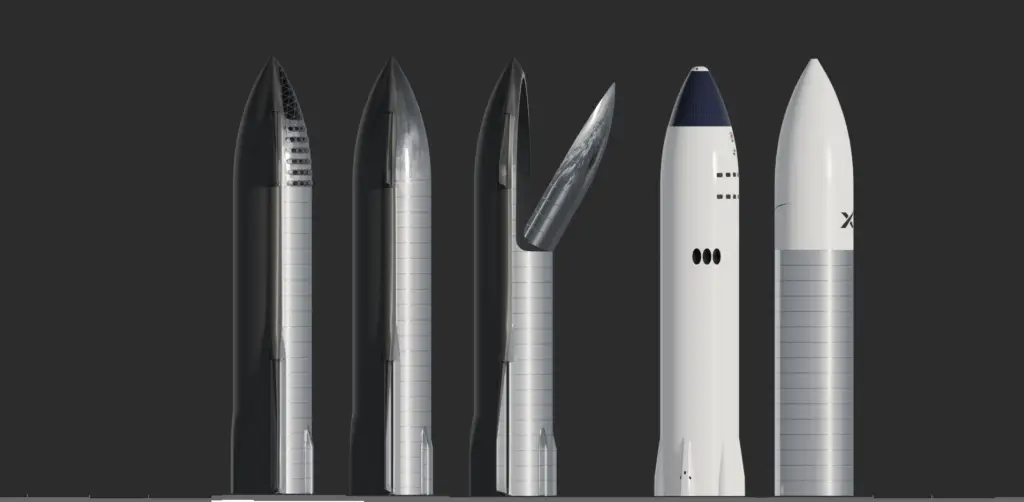
This is perhaps the most powerful idea behind Starship. Instead of thinking about Starship as one spacecraft, it is more useful to think about a family of Starship configurations.
Configuration | Primary purpose |
Cargo Starship | Large payload delivery to Earth orbit |
Tanker Starship | Orbital propellant transportation |
Depot | Long-duration propellant storage in orbit |
Lunar Starship HLS | Crew and cargo transportation to lunar surface |
Mars Starship | Interplanetary crew and cargo transportation |
Cargo lander | Large infrastructure delivery |
Orbital station derivative | Long-duration LEO habitation/industry |
Specialized spacecraft | Potential science, observatory or other missions |
NASA’s Artemis architecture already demonstrates this philosophy: different Starshipvehicles can perform different functions—tanker, depot and lunar lander—while remaining part of the same overall transportation architecture. That is an important engineering concept. The objective is not necessarily to make one Starship configuration do everything. The objective is to create a common platform from which many specialized spacecraft can be produced.
The revolutionary feature of Starship is therefore not simply its size or reducing costs. It is the combination of size + reusability + orbital refuelling + common architecture + high payload volume. More test flights is unlocking more features of this underrated spacecraft, but you can read all these capabilities are designed from the first place by intelligent behind the masterplan.