Starlink V3 to End the Communications Blackout in Spaceflight.
Credit: SpaceX
- October 13, 2026
- CAVU Aerospace UK
Compare Starship reentry live stream with other Vehicles, Even SpaceX’s Dragon.
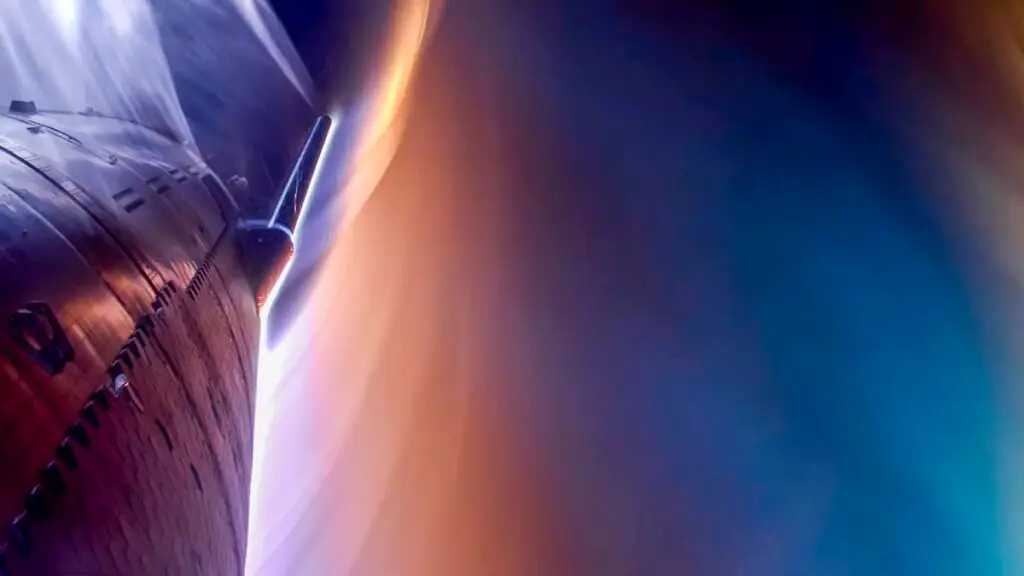
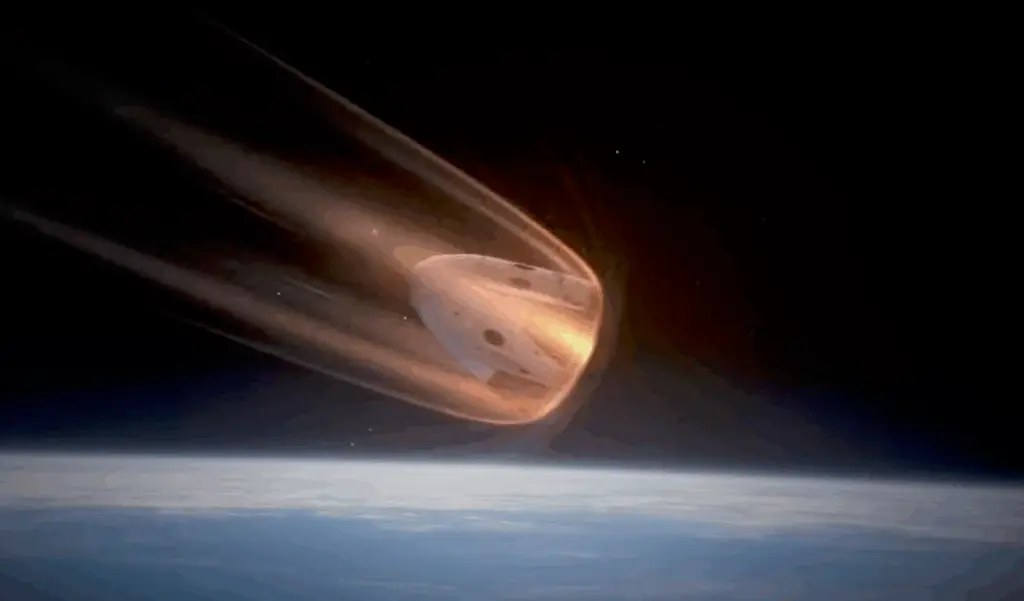
SpaceX’s Starship has brought something remarkable to spaceflight: spectacular live views throughout major phases of a mission. From liftoff and ascent to payload deployment and atmospheric re-entry, its onboard cameras have provided viewers with an unusually continuous view of events that were previously difficult to observe in real time. The difference is particularly striking when comparing Starship’s re-entry footage with the return of conventional crew capsules, such as SpaceX’s Dragon. Dragon missions can provide excellent views during many phases of flight, but the capsule experiences an expected communications blackout during atmospheric entry. During this period, the plasma surrounding the spacecraft can disrupt radio communications, interrupting the live flow of telemetry and imagery.
Starship’s flights 14 demonstrated ability to maintain Starlink connectivity during atmospheric re-entry suggests that this traditional limitation may not be unavoidable for every spacecraft This achievement is not just about producing better videos for the public. Continuous communications can give engineers more information about vehicle performance, thermal protection, aerodynamic behaviour and structural conditions during the most challenging moments of flight. It raises a question that deserves serious consideration across the aerospace industry: if Starlink can maintain connectivity with Starship during re-entry, why shouldn’t other spacecraft benefit from similar technology?
Communications Blackouts
When a spacecraft returns from orbit, it travels through the atmosphere at hypersonic speeds. Air is compressed and heated around the vehicle, creating a region of ionised gas known as a plasma sheath. This plasma can attenuate or reflect radio signals, depending on its electron density and the frequency of the signal. As a result, the spacecraft may temporarily lose its communications link with ground stations or relay satellites. This problem has affected human spaceflight since the earliest crewed missions. Apollo spacecraft experienced re-entry blackouts, and modern vehicles such as Crew Dragon still encounter periods when communications are disrupted. The important distinction is that plasma blackout is not simply a consequence of high temperature. It is an electromagnetic propagation problem influenced by the plasma’s properties, the radio frequency, antenna placement and the geometry of the communications link. Spacecraft are designed to navigate and execute their entry sequences autonomously, so a temporary loss of contact does not necessarily compromise the mission. Nevertheless, the blackout limits the information available to mission control and viewers during a critical phase of flight.
Starship’s communications performance has demonstrated the potential of combining a reusable launch vehicle with SpaceX’s satellite communications network. Instead of relying exclusively on conventional spacecraft-to-ground links, Starlink offers a network-based approach that can relay high-bandwidth data through satellites to ground infrastructure.
Starship has demonstrated Starlink connectivity during atmospheric re-entry, allowing data and imagery to be transmitted through a phase historically associated with communications blackouts. Its live coverage of launch, flight operations, payload deployment and return has helped make complex spaceflight operations more visible than ever. However, the achievement should be interpreted carefully. It does not mean that plasma can no longer interfere with radio waves, nor does it establish that a standard consumer Starlink terminal would work on every spacecraft. The details of Starship’s antenna implementation, radio configuration and performance under different plasma conditions remain important engineering considerations. Nevertheless, the broader principle is compelling: a communications architecture designed to provide high-bandwidth connectivity could potentially support spacecraft throughout more of their missions, including atmospheric entry.
Why Not Equip Dragon, Starliner and Other Vehicles With Starlink V3
If Starlink can support Starship, the next question is whether similar systems could be adapted for Crew Dragon, Boeing Starliner, cargo return vehicles and future reusable spacecraft. There are several potential benefits like Continuous Live Video, Complete Engineering Telemetry, Better Support for Reusable Spacecraft, More Consistent Communications Architecture & better learning for development of vehicles.
The development of Starlink’s next-generation satellites, known as V3, makes this question particularly timely. SpaceX has described V3 as a major step towards greater network capacity and performance, with multi-gigabit-per-second capabilities at the satellite level and improved backhaul capacity. The actual performance available to a particular spacecraft would depend on its terminal, service configuration, network conditions and link geometry.
Higher network capacity could make it easier to support demanding applications, including high-resolution video, engineering telemetry and communications from multiple vehicles operating simultaneously. However, greater satellite-network capacity alone does not solve the atmospheric-entry plasma problem. The radio link between the spacecraft and the satellite must still work under the relevant flight conditions. A high-capacity network cannot recover data from a spacecraft whose signal cannot reach it. The opportunity is therefore to combine improved network infrastructure with purpose-built spacecraft terminals, appropriate antenna placement and a communications system qualified for the flight environment.
The question should not be whether conventional spacecraft communications have become obsolete. They remain essential for command, tracking, telemetry and mission safety. Instead, the industry should consider whether high-bandwidth satellite-network connectivity can become a standard part of future spacecraft architecture. A hybrid system could combine conventional radio links for essential spacecraft operations with Starlink or another suitable satellite network for video, supplementary telemetry and other data-intensive applications.
This would preserve independent safety capabilities while offering the benefits of greater bandwidth and improved visibility. It would also avoid making every spacecraft dependent on one commercial network. Different missions may require different frequencies, relay networks, service providers or dedicated communications infrastructure. The most suitable approach will depend on mission requirements, the operating environment and the consequences of a communications failure.
From Communications Blackout to Continuous Connectivity
Starship has demonstrated that atmospheric re-entry communications can be approached differently. Its impressive live views of launch, payload deployment and re-entry have shown what is possible when high-bandwidth connectivity is integrated into a modern spacecraft. Compared with the intermittent views and expected communications interruptions associated with conventional capsule re-entry, Starship’s coverage has offered a strikingly continuous experience for viewers. More importantly, this capability points towards the potential for richer engineering data throughout flight.
As Starlink moves towards its next generation of satellites, including V3, it is worth asking whether the aerospace industry should begin developing a common, space-rated communications architecture for returning vehicles. The objective would not be to abandon every conventional radio system. It would be to investigate whether Starlink-derived connectivity could provide continuous video and supplementary telemetry across a much wider range of spacecraft, while independent systems preserve mission safety.
Perhaps the next step in spaceflight communications is to stop treating the re-entry blackout as an unavoidable gap in our view of a mission and start treating it as an engineering problem to solve.