
SpaceX Dragon Autonomous Operation Makes Rendezvous and Docking Look Easy!
AI Flight Computers in Future of Orbital Service
Credit: NASA, SpaceX
- October 12, 2026
- CAVU Aerospace UK
Watching a SpaceX Dragon spacecraft approach and dock with the International Space Station through a livestream is one of the most impressive demonstrations of modern space engineering. The spacecraft slowly approaches a structure orbiting Earth at approximately 28,000 km/h, aligns itself with a docking port, makes its final approach, and connects with a precision that can make the entire operation look almost effortless. But make no mistake. Fabulous engineering has made it looks like this, you don’t know how much it takes to do autonomous docking until you actually get to implement it! Apparent simplicity of a docking livestream hides an extraordinary amount of mathematics, computing power, engineering, and risk management.
Docking is not simply about moving one spacecraft towards another. It is about continuously calculating relative motion, predicting future positions, controlling velocity, correcting errors, and making safe decisions in a constantly changing orbital environment.
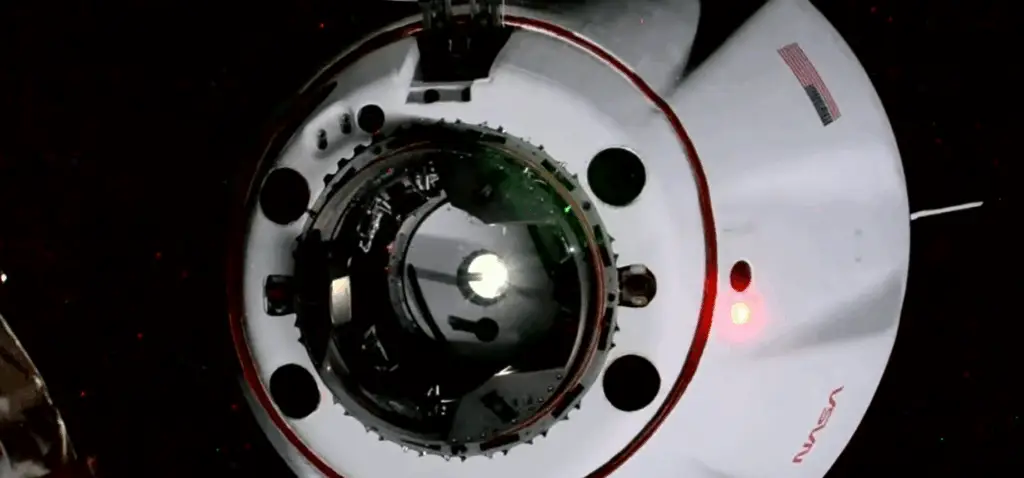
As the space industry moves towards satellite servicing, orbital logistics, reusable spacecraft, autonomous inspection, debris removal, and in-orbit assembly, these capabilities will become increasingly important. AI-enabled onboard computers could play a significant role in this evolution, helping spacecraft understand their surroundings and make increasingly sophisticated decisions without relying on continuous intervention from the ground.
The approaching spacecraft must determine the target’s relative position, velocity, orientation, and rotational motion. Depending on the mission, this information may come from GPS or other satellite-navigation systems, radar, lidar, cameras, optical markers, and inertial sensors. As the distance decreases, the navigation system must transition between suitable sensing and estimation methods. A target that is easy to track from hundreds of metres away may require much more detailed visual processing during the final approach.
The flight computer must calculate a safe trajectory that brings the spacecraft towards the target while respecting constraints on fuel, acceleration, orientation, collision risk, and available manoeuvring time. The spacecraft must account for orbital dynamics, thruster performance, sensor uncertainty, and the possibility that the target itself is moving or rotating.
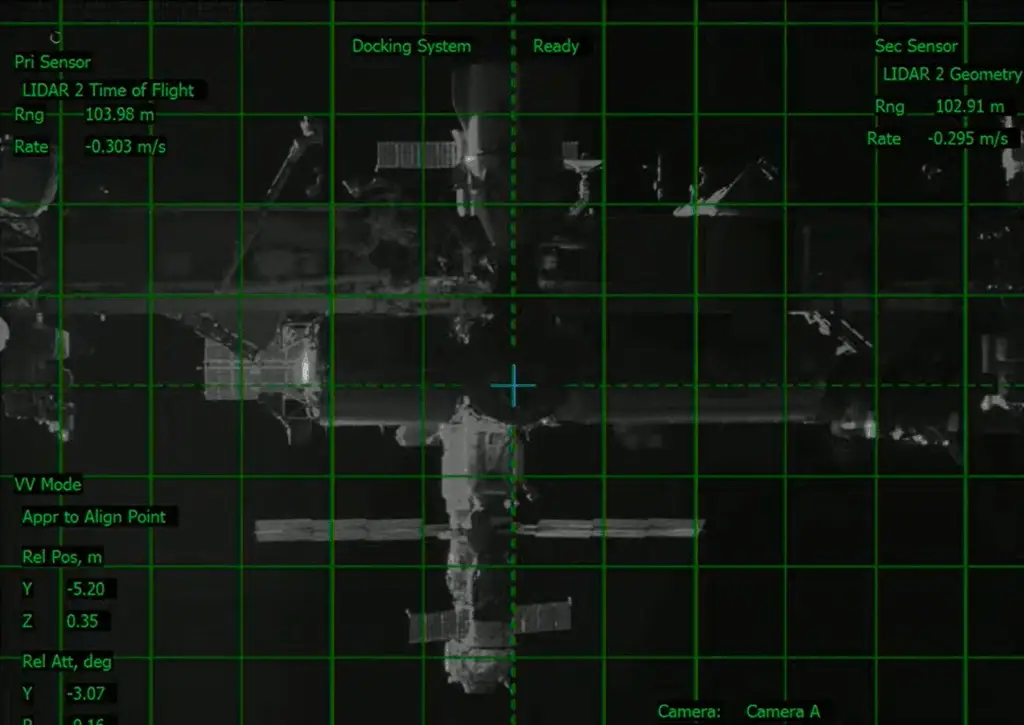
Even a small relative velocity at contact can create substantial mechanical loads. The spacecraft must carefully control its translation and rotation, align its docking mechanism, and remain within permitted approach corridors.
The system must recognise abnormal conditions, assess whether it can continue safely, and execute a suitable response. Depending on the mission, that could mean holding position, retreating to a safe distance, switching sensors, or aborting the docking attempt. These challenges explain why rendezvous and docking are not isolated manoeuvres. They are complete autonomous flight-control problems involving sensing, estimation, prediction, decision-making, and real-time execution.
Autonomous Spacecraft
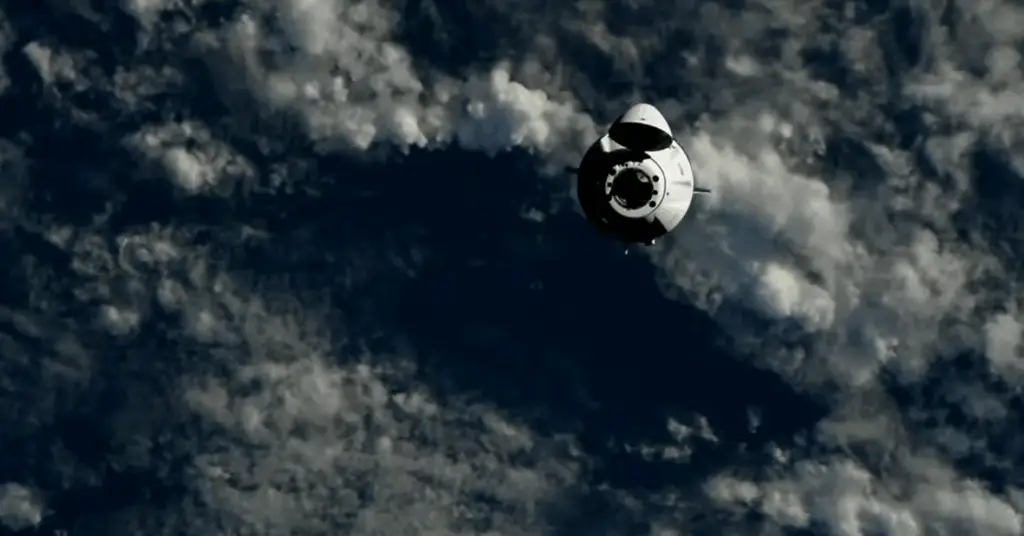
SpaceX Dragon demonstrates how advanced automation can make rendezvous and docking highly repeatable. Its operations combine onboard automation with mission planning, ground monitoring, and safety procedures. Automation does not mean that every decision is made by an AI model, nor that human oversight is unnecessary. The next step is to extend autonomous capabilities to a much broader range of spacecraft and targets. Consider an uncooperative satellite: an object that was not designed to be serviced and may have no active navigation system, docking interface, or communications link available to the approaching vehicle. It could be tumbling, damaged, or operating in an unexpected configuration.
An autonomous servicing spacecraft may need to:
- Detect and identify the target using onboard sensors.
- Estimate its three-dimensional position, attitude, and angular velocity.
- Distinguish the target from background objects and changing illumination.
- Predict how its relative trajectory will evolve.
- Plan a safe approach and continuously update that plan.
- Identify suitable grasping or contact points.
- Detect unexpected motion and respond to faults.
- Decide when to proceed, hold, retreat, or abort.
This is where onboard AI computing becomes particularly valuable. Rather than depending exclusively on predefined procedures and commands transmitted from Earth, the spacecraft can process sensor data locally and respond to its immediate environment. For missions with long communication delays, limited ground contact, or rapidly changing conditions, onboard decision-making can be essential.
AI or Super Intelligence is not a replacement for orbital mechanics, classical control theory, or established flight software. Its greatest value comes from augmenting these systems with capabilities for perception, estimation, adaptation, and decision support. Assisted vision systems can analyse camera images to identify spacecraft features, docking interfaces, solar arrays, structural elements, and potential obstacles. Neural networks can help recognise objects under changing lighting conditions, while conventional computer-vision algorithms can estimate geometric relationships and track features between frames. This becomes particularly important when a spacecraft approaches an unfamiliar satellite whose geometry may not match a predefined target model.
A spacecraft may combine optical measurements, lidar, radar, inertial sensors, and other navigation inputs. Sensor-fusion algorithms can use these complementary sources to estimate the target’s relative state and quantify uncertainty. AI may help classify sensor data, detect unusual measurements, or improve selected estimation tasks. However, safety-critical navigation should retain well-characterised estimation methods and independently validated performance.
Trajectory optimisation and model-based control provide the mathematical foundation for answering that question. AI-based methods may help evaluate complex scenarios, adapt to uncertain conditions, or accelerate parts of the planning process. For safety-critical operations, any learned decision-making system must operate within clearly defined constraints, with verified limits and a reliable way to return to a safe state.
AI-assisted monitoring can help detect unusual sensor patterns, unexpected spacecraft motion, degraded actuator performance, or inconsistencies between predicted and observed behaviour. Combined with a robust fault-detection, isolation and recovery (FDIR) architecture, these capabilities can help the spacecraft identify developing problems earlier and select an appropriate response. The objective is not simply to make a spacecraft intelligent. It is to make it capable of recognising when conditions differ from expectations and responding safely.
AI Onboard Computer
AI algorithms are only one part of the architecture. To use them in space, a spacecraft needs onboard computing hardware that can process sensor data, execute control software, communicate with subsystems, and operate reliably under demanding environmental conditions. Typhoon-Edge is one of flight proven computers used in autonomous orbital service operations using NVIDIA Jetson modules paired with Microchip PolarFire FPGA SoC.
These workloads have different computing requirements. AI inference may benefit from parallel processing and accelerators, while flight control requires predictable timing, deterministic execution, and tightly controlled software behaviour. This is why the architecture of an AI-enabled flight computer matters just as much as its peak processing performance. A processor that offers impressive AI performance but cannot reliably support the spacecraft’s safety-critical functions is not, by itself, a suitable autonomous docking computer.
As commercial activity in orbit expands, autonomous rendezvous and docking could support an increasingly broad range of services.
Satellite servicing and life extension: Servicing spacecraft could inspect, repair, refuel, or upgrade satellites, potentially extending their useful lives and reducing the need to replace them.
Active debris removal: Autonomous vehicles could approach selected pieces of orbital debris and capture or deorbit them, subject to the significant technical and operational challenges involved.
In-orbit assembly: large structures could be constructed from smaller modules launched separately, requiring spacecraft to navigate towards and connect with other elements.
Orbital logistics and reusable vehicles: Future orbital transport systems could transfer cargo, reposition assets, and connect with other vehicles with increasing levels of automation.
Inspection and proximity operations: Satellites could approach other spacecraft to inspect damage, verify configuration, or investigate anomalies without requiring every manoeuvre to be commanded individually from Earth.
Lunar and deep-space operations: Autonomous rendezvous techniques could also support spacecraft operating farther from Earth, where communication delays and limited opportunities for direct control make onboard autonomy particularly valuable.
These applications will not all require the same level of AI. Some missions may need only conventional automated guidance and navigation, while others may benefit significantly from advanced perception and adaptive planning. The right solution depends on the target, operational environment, and acceptable risk. Nevertheless, the broader direction is clear: as more services are performed in orbit, onboard computers will need to do more than execute commands. They will increasingly need to interpret their environment and respond intelligently within carefully defined safety limits.