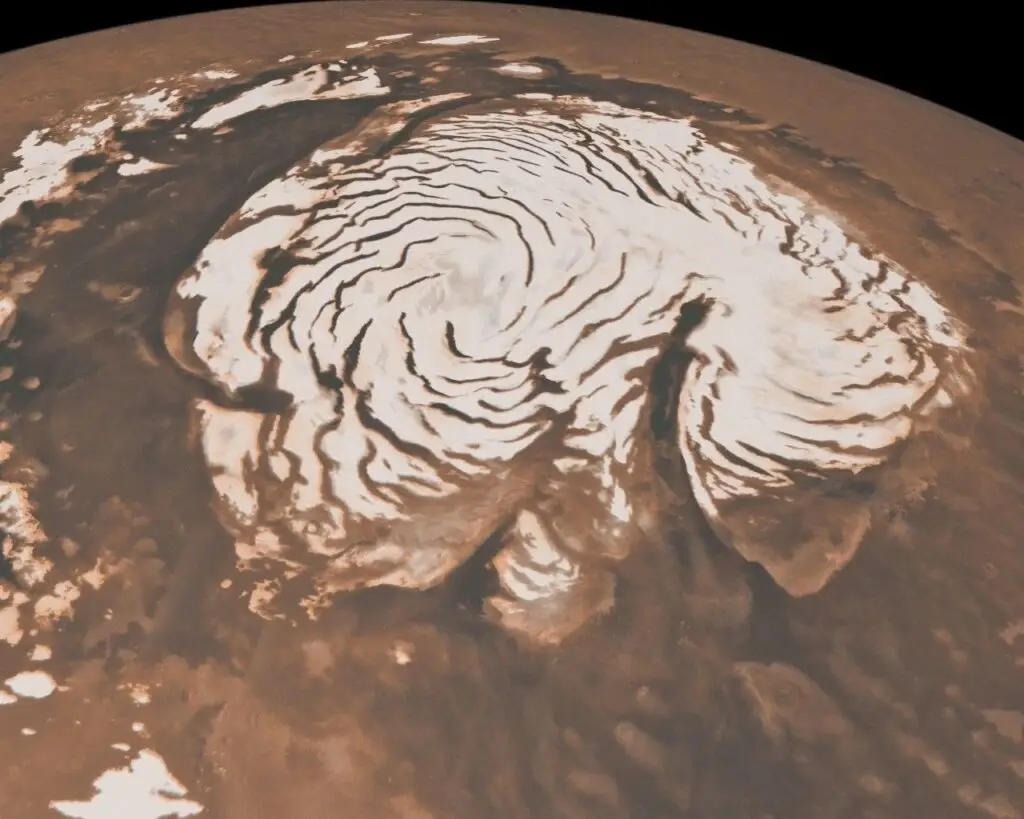
Detecting Neutral Messengers from Space, Science Fleet 2,000 km deep at Antarctica Ice Cube.
Idea: How about deploying Neutrino Observatory detectors on the Ice depots of Moon / Mars where much thinner atmosphere can help better?
- October 10, 2026
- CAVU Aerospace UK
Humanity science fleet to expand our understanding of universe is mostly in deep space, Lagrange points to enable us to look at the past & unlock universe mysteries. Hubble, Swift, JWST, Roman, Voyagers, Moon rovers, Mars Rovers are key players in humanity science fleet. But in October 2026, the world of physics turned its attention to an extraordinary scientific instrument buried deep beneath the ice at the South Pole after winner of 2026 Physics noble prize announced. The IceCube Neutrino Observatory was built to detect one of the most elusive particles known to science: the neutrino. Its success has opened a completely new way of observing the universe — not by collecting light, but by detecting particles that can travel across enormous cosmic distances almost completely undisturbed.
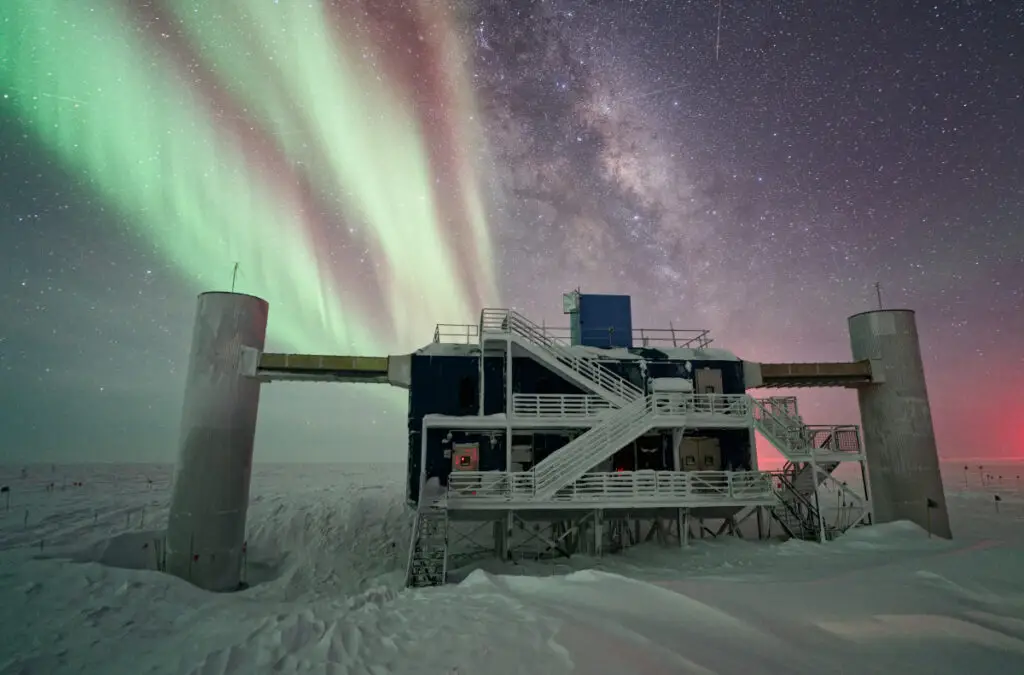
The importance of this achievement was recognised when Francis Halzen was awarded the 2026 Nobel Prize in Physics for his decisive contributions to IceCube and the discovery of high-energy neutrinos of astrophysical origin. A neutrino is an elementary subatomic particle with an extremely small mass and no electric charge. It is sometimes described as a “ghost particle” because neutrinos interact with matter extraordinarily weakly. Trillions of neutrinos pass through our bodies every second, yet almost all of them travel straight through without interacting with a single atom. This property makes neutrinos difficult to detect — but it also makes them extraordinarily valuable to astronomy. Unlike charged particles, neutrinos are not significantly deflected by magnetic fields. And because they interact so weakly, they can travel enormous distances without being absorbed by the matter between their source and Earth. That makes the particle a natural messenger from space.
Neutrinos are produced whenever nature creates certain nuclear or particle reactions. There are several major sources.
Some neutrinos were produced during the earliest moments of the universe. As the universe expanded and cooled, enormous numbers of neutrinos continued travelling through space. Scientists believe that this ancient population forms a cosmic neutrino background, somewhat analogous to the better-known cosmic microwave background. These particles have been travelling for billions of years. They are effectively fossils from the earliest universe.
Another is stars. Stars are enormous nuclear reactors. Inside the Sun, nuclear fusion converts hydrogen into helium. These reactions produce neutrinos that escape the Sun and travel directly toward Earth. Unlike sunlight, which can take a very long time to diffuse through the Sun before reaching the surface, neutrinos can escape from the nuclear reaction regions and travel outward essentially unhindered. By detecting solar neutrinos, scientists can therefore look directly into the nuclear engine of the Sun.
Supernova explosions- When a massive star reaches the end of its life, its core can collapse in a spectacular event known as a supernova. These explosions can release enormous numbers of neutrinos. A supernova therefore produces not only visible light, but also an enormous burst of neutrinos. This is particularly important because the neutrinos can escape from regions that may initially be opaque to electromagnetic radiation. Neutrinos can therefore provide information about what is happening inside a stellar explosion.
Black holes and neutron stars- Some of the most extreme environments in the universe exist around black holes and neutron stars. Matter falling toward a black hole can be accelerated to enormous energies. Relativistic jets can extend thousands or even millions of light-years into space. Neutron stars can also produce incredibly energetic particle environments. When high-energy cosmic rays — particularly protons — collide with surrounding matter or radiation, they can generate secondary particles that eventually produce neutrinos. The resulting neutrinos can then escape their birthplace and travel across the universe.
Cosmic-ray accelerators- The universe contains natural particle accelerators vastly more powerful than anything humans have built on Earth. Cosmic rays can reach energies millions of times greater than those achievable by terrestrial particle accelerators. When these particles interact with matter or radiation, neutrinos can be produced.
This creates an extraordinary possibility. Instead of building a larger particle accelerator on Earth, we can use the universe itself as the accelerator. IceCube allows scientists to study the particles produced by these natural cosmic accelerators.
Astronomy has traditionally relied on electromagnetic radiation. We observe the universe using radio waves, microwaves, infrared, visible light, ultraviolet, X-rays, gamma rays & humanity has built great detectors mostly in orbit to detect whats happening in universe to help expand our understanding to universe. Each part of the electromagnetic spectrum reveals different information. But electromagnetic radiation can be absorbed, scattered or blocked.
Neutrinos are different. They can pass through enormous amounts of matter and travel through the universe without being significantly deflected by magnetic fields. This means that their direction can point back toward their source. The result is a new form of astronomy deep into ice at earth south pole. IceCube is effectively allowing scientists to observe the universe using particles instead of light. The IceCube collaboration describes neutrinos as astronomical messengers capable of carrying information from some of the most violent processes in the universe.
This is where the connection to space becomes extraordinary. Imagine a violent event occurring billions of light-years away. A powerful astrophysical accelerator produces cosmic rays. Those particles interact with matter or radiation near the source. Neutrinos are produced. The neutrinos escape. They travel across intergalactic space. They pass through galaxies. They pass through the Milky Way. They pass through Earth & very rarely; one interacts inside the Antarctic ice. IceCube detects the resulting flash. Scientists can then work backwards to determine where that neutrino came from. The detector is therefore effectively connecting a few cubic kilometres of Antarctic ice with astrophysical events occurring across the universe.
Consider a black hole surrounded by enormous quantities of matter. Electromagnetic radiation produced deep inside the environment may be absorbed or scattered before it can escape. A neutrino, however, may pass directly through. This gives astronomers a fundamentally different view. Light tells us what reaches us electromagnetically. Cosmic rays tell us about high-energy charged particles, although magnetic fields can change their trajectories. Neutrinos can potentially tell us about the location and physics of the accelerator where they were produced. Together, these observations create what is increasingly called multi-messenger astronomy. The universe is no longer being studied through one type of messenger. We can combine Light + gravitational waves + cosmic rays + neutrinos. Each provides a different piece of the same cosmic event.
Physics Noble Prize, 2026
Francis Halzen’s achievement was not simply the construction of a particle detector. It was a conceptual change in how we observe the universe. The idea was remarkably elegant. Instead of constructing an enormous artificial detector, use something that nature has already provided — a massive volume of transparent Antarctic ice. The result is the first detector of its kind operating on a gigaton scale. IceCube demonstrates that an environment that appears empty and inaccessible can become an enormous scientific instrument. The Antarctic ice is no longer simply frozen water. It is part of a telescope. He didn’t think project will be possible to build, until he actually built it.
The most important lesson from IceCube may be that the universe is not merely something we observe from a distance. The universe is constantly sending particles toward us. Every neutrino carries information about the physical conditions under which it was created. A neutrino may have been produced inside a star, during a supernova, near a black hole, inside a relativistic jet, during a collision involving cosmic rays or in the early universe itself. After travelling for millions or billions of years, it can finally interact with a tiny fraction of the Antarctic ice. That interaction allows humanity to reconstruct part of its journey.
The IceCube Observatory represents an extraordinary intersection between Earth and space. The detector sits beneath approximately two kilometres of Antarctic ice, yet its scientific reach extends billions of light-years beyond Earth. It transforms a natural resource into a telescope and turns nearly invisible particles into astronomical messengers. The 2026 Nobel Prize awarded to Francis Halzen recognises this fundamental change in our ability to explore the cosmos. For centuries, astronomy was primarily the science of looking at the universe. Now we are beginning to listen to it through particles. And among the quietest messengers arriving from deep space, neutrinos may be telling us some of the universe’s most violent stories.
Now question is why not deploying Neutrino Observatory detectors on the Ice depots of Moon / Mars where much thinner atmosphere can help better? Results should be much better than Ice Cube.