
Natural Propulsion to Lower-Cost Spaceflight
Case: Comet 41P
Credit: NASA
- October 9, 2026
- CAVU Aerospace UK
Spacecraft normally carry their own propellant. Every kilogram of fuel launched from Earth adds mass, requires additional launch energy, and increases the complexity and cost of a mission. But nature has already demonstrated another way to generate propulsion. Comet 41P/Tuttle–Giacobini–Kresák provides a remarkable example.
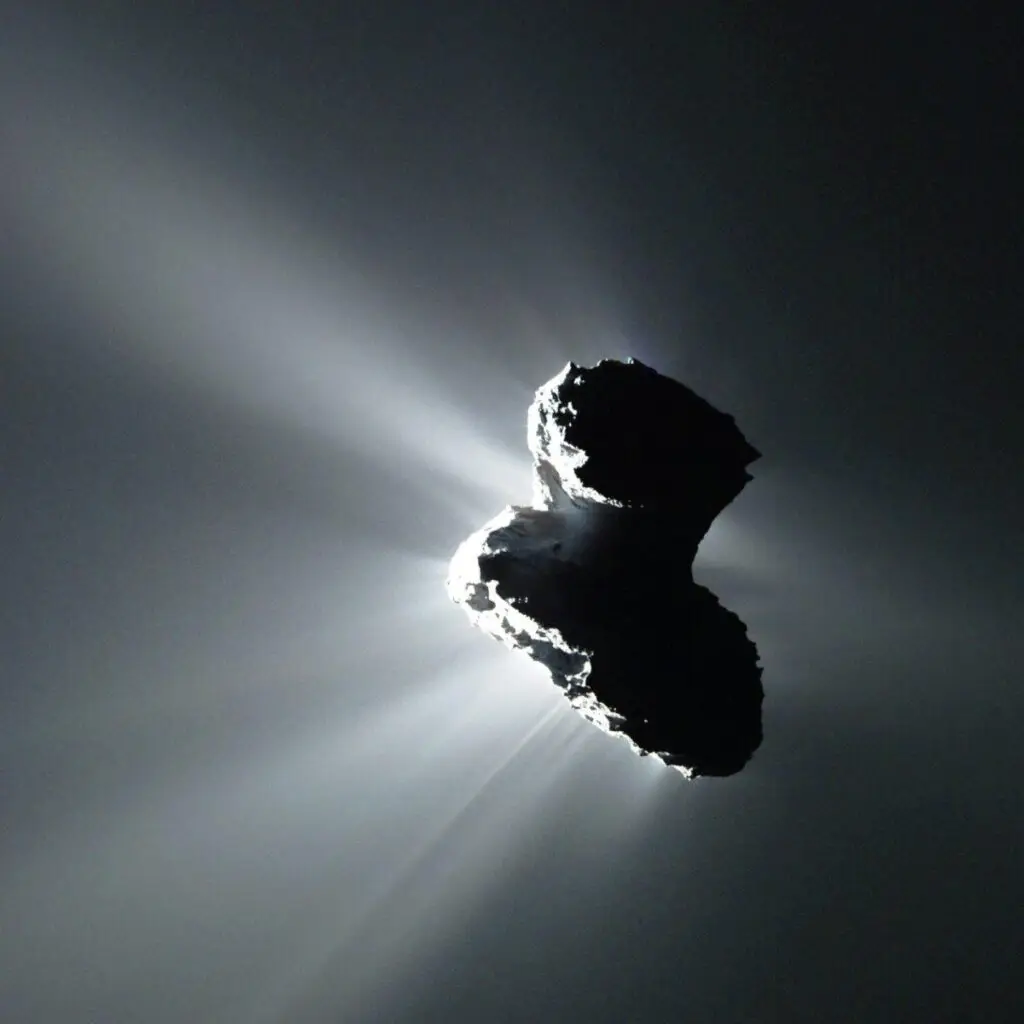
When a comet approaches the Sun, solar radiation heats its surface. Ice does not necessarily melt into liquid water; in the vacuum of space, exposed ice can sublimate directly from solid to gas. The escaping gas and dust form jets that extend away from the comet. Those jets carry momentum.
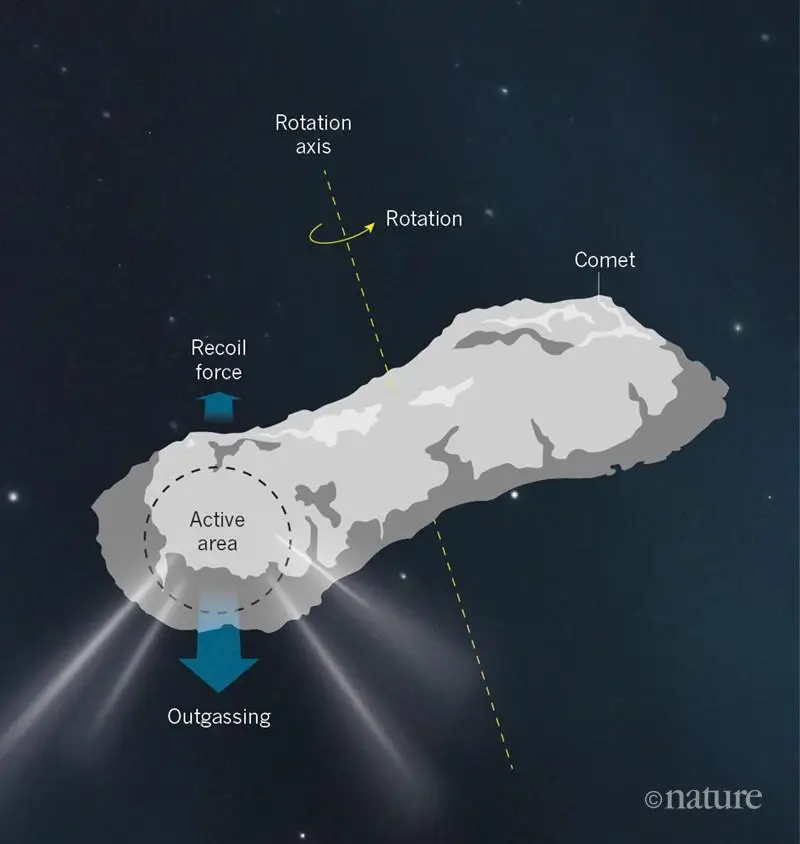
By Newton’s third law, the comet receives an equal and opposite reaction force. In other words, the comet naturally generates thrust using sunlight as its energy source and its own ice as reaction mass.
The effect was particularly dramatic for 41P. During its 2017 passage through the inner Solar System, observations showed that its rotation period increased from approximately 20 hours to more than 46 hours in only a few months. Scientists concluded that gas escaping from the comet in an uneven pattern generated a strong torque on the nucleus. NASA describes the process in remarkably simple terms: as the comet approaches the Sun, heating causes surface ice to turn directly into gas, producing jets. Those jets can behave like small thrusters. More recent analysis of Hubble observations indicates that 41P may even have undergone a reversal of its rotation direction after the 2017 perihelion passage, apparently driven by continued outgassing torque.
The important engineering principle is therefore: Solar energy → ice sublimation → high-speed gas → momentum transfer → thrust. No chemical combustion is required.
The idea can be extended beyond natural comets. Imagine a spacecraft carrying a reservoir of water or another volatile material. Instead of burning chemical propellant, the spacecraft uses concentrated sunlight to heat the volatile material. The process could look like this:
Sunlight
↓
Solar concentrator / thermal system
↓
Water or other volatile material
↓
Sublimation / vaporisation
↓
Nozzle
↓
High-velocity exhaust
↓
Continuous low thrust
The spacecraft would effectively turn sunlight into propulsion while consuming a relatively simple and potentially abundant propellant. This is not “free” propulsion. The spacecraft still consumes reaction mass, and the solar energy must be collected. However, the energy source is provided by the Sun rather than by carrying all of the energy in chemical propellant from Earth. That distinction could become increasingly important for missions operating far from Earth.
The most interesting possibility is not necessarily replacing conventional rocket engines. Instead, natural sublimation propulsion could complement conventional propulsion systems. A spacecraft could use chemical propulsion for launch, injection and major manoeuvres, and then use solar-driven sublimation for smaller but long-duration trajectory corrections.
- For Earth departure, A conventional launch vehicle places the spacecraft into orbit or onto an initial escape trajectory.
- For Solar approach, Once the spacecraft is in space, large solar collectors concentrate sunlight onto a volatile propellant reservoir.
- For Propellant sublimation, the absorbed solar energy converts the stored volatile material into gas.
- For Controlled exhaust, A nozzle directs the gas to generate thrust.
- For Long-duration acceleration, the thrust may be relatively small, but it can operate for weeks, months or even years.
One of the biggest misconceptions about propulsion is that useful propulsion must produce enormous instantaneous thrust. For interplanetary transportation, thrust duration can be just as important as thrust magnitude. If a spacecraft continuously accelerates, even a small acceleration can eventually produce a significant change in velocity.
This concept becomes even more interesting when combined with in-space resource utilisation. Water is particularly attractive because it can potentially serve several purposes:
- propulsion reaction mass;
- thermal management;
- radiation shielding;
- life-support feedstock;
- hydrogen/oxygen production;
- cryogenic propellant production.
Instead of transporting every kilogram of consumable material from Earth, future infrastructure could obtain volatile materials from asteroids, comets, the Moon or other planetary bodies. The spacecraft then becomes less dependent on Earth-launched propellant. The long-term objective would be to move progressively more of the propulsion infrastructure away from Earth’s gravity well.
Comets are natural examples of solar-powered propulsion. 41P demonstrates something particularly valuable for spacecraft engineers. The comet does not carry a conventional engine. It does not have a combustion chamber. It does not have a turbopump. It does not carry an oxidiser. It does not need an electrical power source. The Sun provides the energy. The comet provides the reaction mass. Its surface geometry determines where the material escapes. And the resulting momentum transfer changes both its trajectory and its rotation.
NASA’s observations of 41P showed that more than half of its surface area appeared to contain sunlight-activated jets during the 2017 apparition, an unusually high active fraction compared with typical comets. The comet therefore acts as a naturally occurring demonstration of solar thermal propulsion using volatile material.
Potentially, but the greatest cost reduction would probably come from reducing the amount of propellant that must be launched from Earth, rather than simply replacing today’s rocket engines. Consider a future spacecraft travelling from Earth to Mars. A conventional architecture might require the spacecraft to launch with a substantial quantity of propellant.
The engineering challenge is to transform the natural process into a controllable propulsion system. A spacecraft would need to control heat input, Mass flow, Exhaust direction, Attitude, Propellant management & Solar-distance dependence. This means solar-sublimation propulsion would be particularly attractive in the inner Solar System and would require increasingly large collectors or alternative energy sources farther from the Sun.