
Building the Moon Base 2029-2040
Lunar Economy Taking Shape in next 10 years
- September 14, 2026
- CAVU Aerospace UK
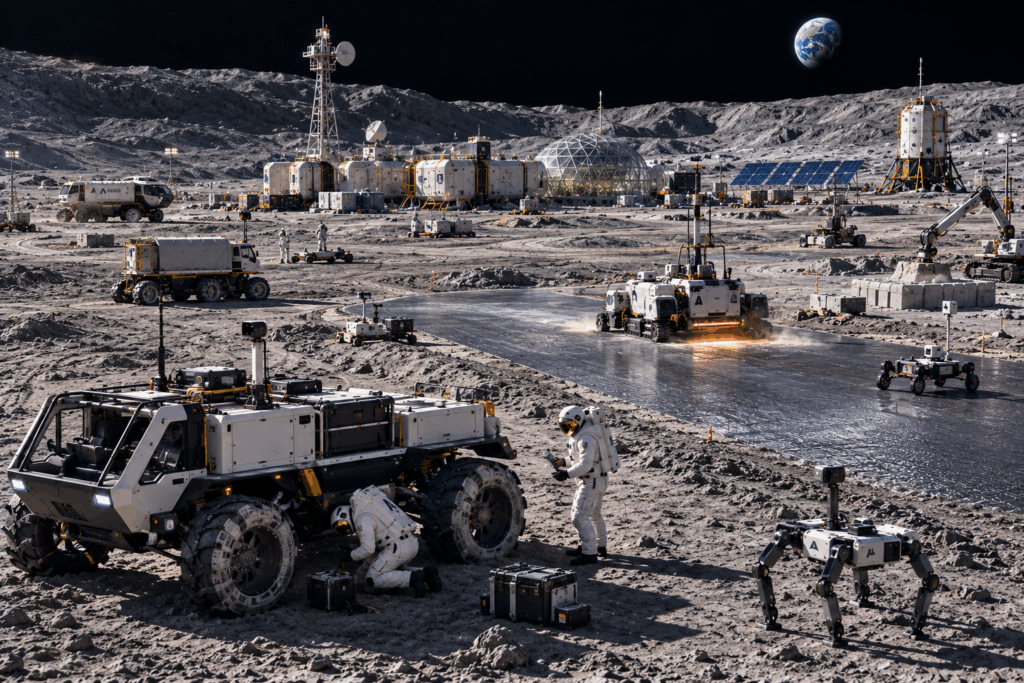
Building a permanent human presence on the Moon will not start with astronauts constructing houses, it will start with robots to prepare before human long-term presence. In foundation period starting from 2029 Moon Base looks like a junk yard, construction ongoing in Moon base & astronauts will have 28 days long mission on lunar surface with specific tasks to help set up Moon base & do science, similar to experiences on ISS. A decade of foundation period should prepare longer stay presence for human & build a platform to prepare & launch spacecrafts to go to Mars & beyond. Artemis program is going to secure presence of human on the Moon this time.
Moon base after foundation period will have a long runway for launch to Mars.
One of the basic construction works is to set up some landing sites, baking lunar soil to make it more solid to avoid lunar dust cover everything & raise technical issues with machinery. There would be several Moon Rovers & vehicles to move cargo & astronauts, some even with pressurized cabin. NASA’s current Moon Base architecture envisions a gradual transition from robotic exploration to infrastructure development and eventually to long-duration human operations near the lunar South Pole. The reason is straightforward: before astronauts can live safely on the Moon, someone—or something—must prepare the site.
That means landing cargo, generating power, establishing communications, deploying vehicles, preparing working areas, managing lunar dust, creating landing and transport surfaces, and eventually learning how to manufacture useful materials from lunar soil.
NASA currently divides this development into three broad phases:
- Phase One, now–2029: gain reliable access, experiment and learn.
- Phase Two, 2029–2032: build and expand early infrastructure.
- Phase Three, 2032 onward: establish an enduring human presence.
The lunar South Pole is selected for Moon base for two major reasons: illumination and water. Some elevated locations receive sunlight for unusually long periods, potentially providing valuable solar power. At the same time, deep craters contain permanently shadowed regions where temperatures can remain extremely low and water ice can survive for geological periods.
There are steep slopes, large rocks, deep shadows, extreme temperature gradients, poor lighting conditions and abrasive regolith. NASA describes the region as one of the most challenging environments for sustained human operations. The objective is therefore not simply to find a flat piece of ground. The objective is to create a usable operating zone.
Moon Base will be a construction site for a decade
Before astronauts can routinely live there, the surface needs infrastructure. A simplified sequence could look like preparing Landing sites, setting up power stations, setting up communications, driving vehicles, site preparation for shelters, dust control mechanism like roads, cargo handling, building long stay habitat, starting extraction of resource & expanding infrastructure of Moon base over a decade which ultimately can secure human permanent presence for science & preparation to act like a science centre & refuel station & runway to go to Mars & beyond.
The first machines will need to unload themselves and each other, move equipment, inspect the terrain and prepare areas for subsequent missions. NASA’s current Moon Base plans specifically identify:
- power generation and storage;
- communications;
- cargo transportation;
- lunar terrain vehicles;
- landing pads;
- roads and prepared working areas;
- regolith manipulation;
- water and oxygen extraction;
- dust mitigation;
- habitation systems.
This is essentially the beginning of a small industrial ecosystem which even in foundation period will have multi-billion lunar economy.
Case: Turning Moon dust into a road
Imagine a robotic construction vehicle arriving before the astronauts. It could survey the terrain, remove large rocks, grade the surface, compact the regolith, apply concentrated energy, melt or sinter the upper layer, allow it to solidify & repeat the process across the required area.
The objective is to prevent loose dust from being thrown around by rocket exhaust and vehicle movement. A landing pad is particularly important. When a large lunar lander fires its engines close to the surface, the exhaust can accelerate loose regolith to extremely high velocities. Those particles can damage nearby equipment, solar arrays, antennas, vehicles and potentially other spacecraft. A hardened landing zone therefore becomes an important piece of Moon Base infrastructure.
The 28-day missions
The 28-day number becomes particularly interesting when viewed as a logistics problem. NASA’s current Moon Base architecture uses a reference case of approximately 4 astronauts × 28 days. with approximately 8,000 kg of carriers, consumables and other supporting items in the logistics example.
That mass isn’t simply food. It represents the broader logistics burden of supporting the crew and surface operation. A 28-day expedition could require:
Human consumables, Life support, EVA operations, Surface operations, Power, Maintenance etc. This is why a Moon Base is fundamentally a logistics architecture, not simply a building.
The lunar vehicles
Mobility is critical because astronauts cannot walk everywhere in a spacesuit. NASA’s Lunar Terrain Vehicle program is developing unpressurized vehicles capable of carrying astronauts and cargo. The vehicles can also be operated by astronauts, remotely from Earth or move autonomously.
NASA new way to use commercial space companies in lunar economy has been leading in competition in space & technology companies to try develop lunar vehicles for Artemis program & missions to come. Ultimate goal is to pick up a lot of mobility demands for humanity during Moon base foundation period & afterward. Astrolab’s Crewed Lunar Vehicles are great example of technology developed by commercial space firms chosen by NASA to operate on Moon base. It can transport astronauts, tools, scientific instruments and cargo across the surface.
Toyota’s Lunar Cruiser represents another class of vehicle. Rather than an open, unpressurized rover, Toyota and JAXA have been developing the concept of a pressurized lunar rover. Think of it as vehicle + laboratory + lunar RV.