
Rocket Flight Computer: PolarFire SoC and a High-Density I/O Interface for Vehicle Control
A single flight-computing platform for dozens of sensors, valves, auxiliary loads and TVC actuators
- September 6, 2026
- CAVU Aerospace UK
A modern rocket flight computer has to do far more than execute a flight-control algorithm. During operation, it may need to continuously monitor dozens of pressure sensors, track temperatures throughout the propulsion and vehicle systems, monitor battery voltages and currents, control multiple solenoid valves, switch auxiliary loads and command high-current thrust-vector-control (TVC) actuators. Several measurements & driving many actuators with reliable HiPer-D glenair connectors make a reliable flight computer for harsh environment of launch. Few reliability assessment on performance of computer has been carried out by third parties & reliability index of flight computer for launch missions with short duration of 7 minutes is estimated above 99.999%.
These functions also have very different electrical and timing requirements. This creates a fundamental engineering challenge: How can a flight computer combine high-performance processing, deterministic real-time control, high-channel-count analogue acquisition and high-power actuator interfaces in a compact architecture?
The OBC-Hyper-Polar, based on the Microchip PolarFire SoC FPGA, addresses this challenge by separating the system into two complementary layers. OBC-Hyper-Polar provides the computing and deterministic control intelligence, while a dedicated application-specific add-on card provides the high-density vehicle I/O and power interfaces. The result is a flexible flight-computer architecture capable of connecting directly to a complex rocket’s sensors and actuators without turning the main computer into a large collection of dedicated interface electronics.
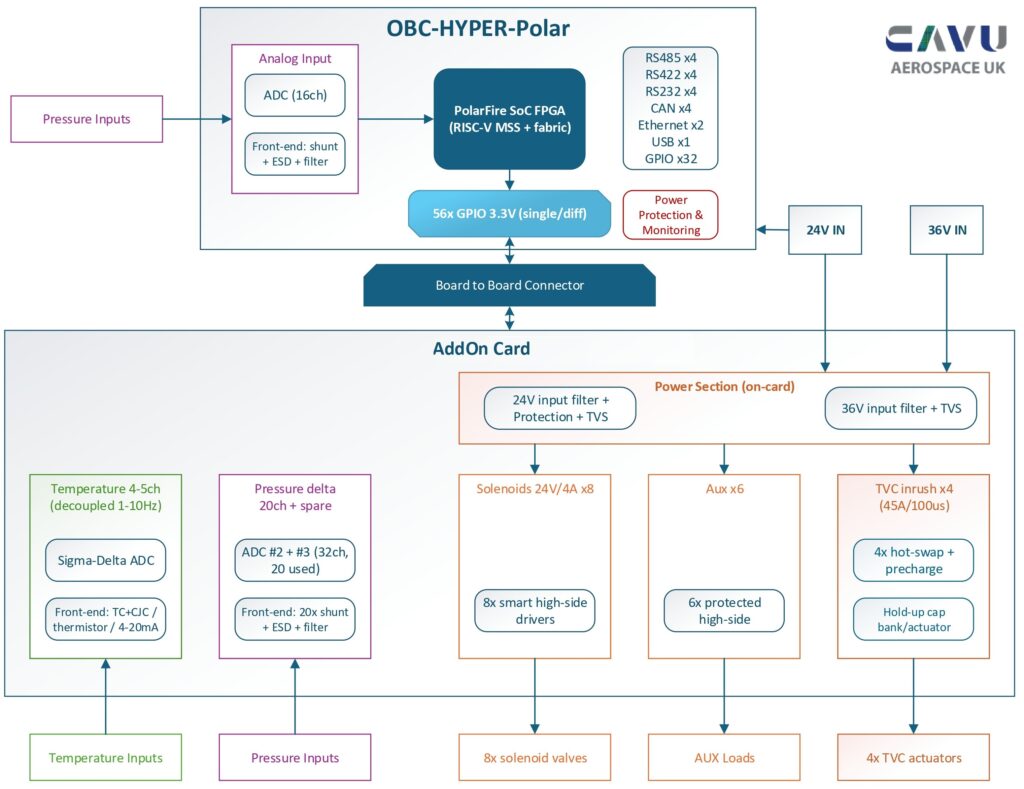
The architecture: computing core + mission-specific I/O
The flight computer consists of two tightly integrated boards.
The main OBC provides PolarFire SoC FPGA, RISC-V processor subsystem, FPGA programmable fabric, 16-channel analogue acquisition, Digital I/O, Vehicle communications interfaces, Power protection and monitoring, Real-time processing & Flight-control software execution.
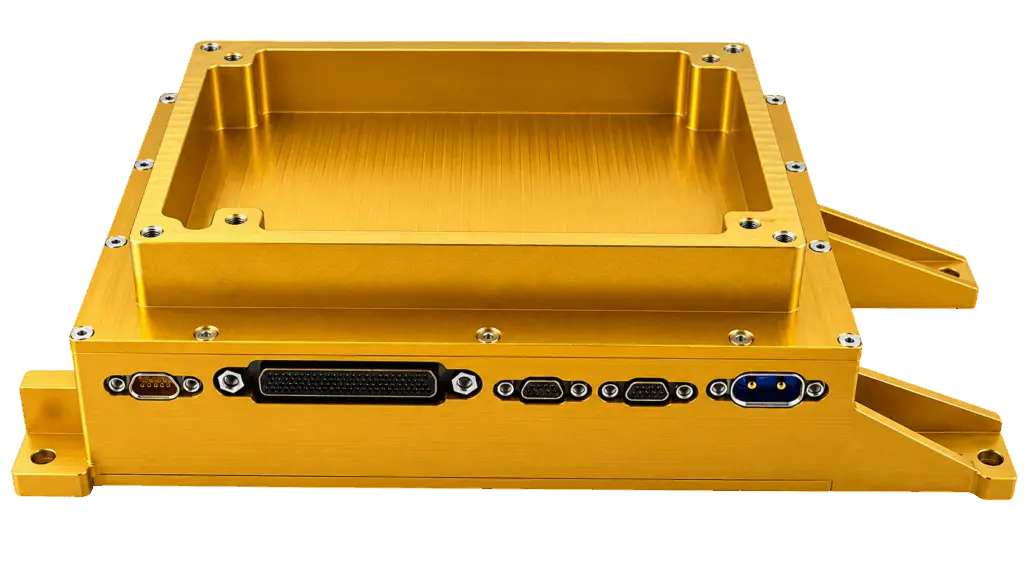
Computer chassis can be bespoke design to have best fit with mounting position of computer.
Application-specific add-on card
The add-on card expands the flight computer with dedicated interfaces for:
- 32 pressure sensors
- 4 additional pressure sensors through the main OBC
- Temperature sensors
- Battery voltage monitoring
- Battery current monitoring
- 12 solenoid valves
- 12 auxiliary loads
- 6 high-current TVC actuators
The boards are connected through a Samtec board-to-board interface, keeping the high-density vehicle wiring and high-power interfaces on the application-specific card while maintaining the OBC as the central processing platform.
Pressure channels from a single flight computer
One of the most striking characteristics of this architecture is its pressure-measurement capability. The add-on card contains two dedicated pressure connectors:
- J_PRESS_A: pressure sensors 1–16
- J_PRESS_B: pressure sensors 17–32
Each connector supports 16 two-wire, 24 V loop-powered 4–20 mA pressure sensors.
The use of 4–20 mA instrumentation provides an important advantage for a vehicle with distributed sensors.
Instead of sending a small voltage signal over potentially long wiring harnesses, the pressure information is represented as a current. The add-on card therefore provides a complete sensor interface:
24 V sensor supply
↓
Pressure transducer
↓
4–20 mA current loop
↓
150 Ω shunt + protection/filtering
↓
ADC
↓
PolarFire FPGA
↓
Flight software
The FPGA can then process all pressure channels concurrently. This provides opportunities for Pressure filtering, Sensor calibration, Limit checking, Rate-of-change monitoring, Sensor plausibility checks, Fault detection, Propulsion-system monitoring & Automated responses to abnormal conditions.
The main OBC’s analogue interface also allocates channels for temperature measurement. The current allocation includes Five NTC temperature channels & One current-loop temperature channel. The NTC channels are intended for 10 kΩ NTC sensors, using the existing OBC temperature analogue front end.
This allows temperature measurements to be processed alongside the pressure data rather than requiring a separate temperature-monitoring computer. The result is a unified vehicle-health data set:Pressure + temperature + electrical measurements + actuator status
all available to the same flight-control architecture.
The flight computer also monitors the electrical system itself. Three dedicated analogue channels are allocated for 12 V, 24 V & 36 V battery monitoring
Solenoid valves, AUX Loads & TVC Actuators Control
The add-on card provides a dedicated MDM-21 solenoid connector with eight switched 24 V outputs. The eight channels are SOL_1 to SOL_8. Each channel is specified for approximately 0.25–0.75 A and includes an individual return path. The flight computer can therefore control eight solenoid valves independently. Similar case with several independently controlled AUX loads & TVC actuators connecting with computer.
The combination of OBC-Hyper-Polar and its application-specific I/O card demonstrates a different approach to rocket avionics. Instead of treating the flight computer as simply a CPU surrounded by fixed peripherals, the system uses the PolarFire SoC FPGA as a programmable real-time control platform.
The result is a flight computer capable of simultaneously seeing the vehicle, understanding its state and controlling its critical systems. 32 pressure channels. Multiple temperature and electrical measurements. 12 solenoids. 12 auxiliary loads. 6 high-current TVC channels. One PolarFire SoC-based flight computer. OBC-Hyper-Polar turns a programmable FPGA-based onboard computer into a scalable flight-control platform capable of interfacing directly with the complex electrical and sensing architecture of a modern rocket.