Enabling Higher-Power Satellite Thermal Control with High-Current, EMI-Optimized Glenair HiPer-D Connectors
- September 3, 2026
- CAVU Aerospace UK
Thermal control is becoming increasingly important for deep space exploration missions as spacecraft electronics become more powerful and more complex. High-performance processors, payload electronics, optical systems and other onboard equipment can generate significant amounts of heat, while spacecraft operating environments can also demand substantial heater power to maintain components within their required temperature ranges. Specially with aggressive timeline for Artemis program for landing on the Moon & building Moon Base, heating at long lunar nights is big challenge.
For thermal control units with limited power & 48 heating channel, this creates a fundamental engineering challenge how can significantly higher heater power be delivered through a compact spacecraft interface while maintaining reliability and electromagnetic compatibility. With several experiences in different variations of TCU, it turned out Glenair HiPer-D connectors with high-rating pins could be best fit to mission requirements. TCU addresses this challenge with an upgraded high-power architecture combined with Glenair HiPer-D® Combo connectors, providing a high-current interface capable of supporting demanding spacecraft heating applications. For example, 7A heating channel & total input power of 4,000W is manageable with 40A per pin power connector. 2-pin gives 80A input power & will be more than a challenging mission requires.
TCU is developed in several configurations to accommodate different spacecraft and mission requirements. Depending on the version, the systems can provide different radiation-performance levels, temperature measurement capabilities, numbers of heater channels and current ratings per channel.
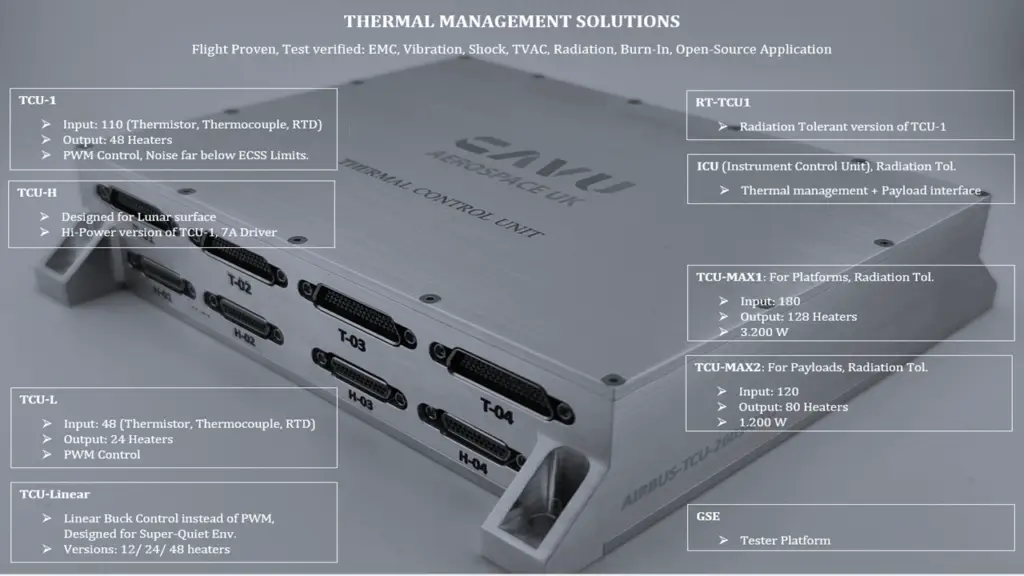
The latest upgraded TCU increases the heater capability to 7A per channel, while the total TCU input power can reach above 4,000 W. At this power level, the connector is no longer simply an electrical interface. It becomes an important part of the thermal-control system architecture. Traditional connectors are generally designed around relatively low-current signal and control applications. Moving several kilowatts scale of power through a spacecraft interface requires a different approach, with careful consideration of contact current capability, electrical losses, thermal behaviour, mechanical robustness and electromagnetic compatibility.
High-current capability in a compact connector
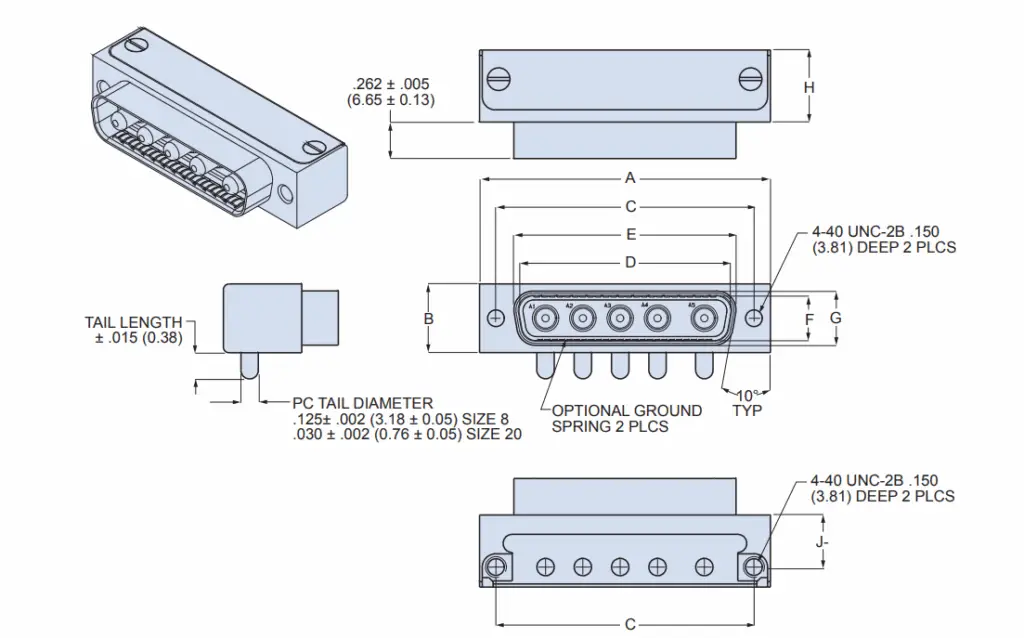
The Glenair HiPer-D® is a high-performance development of the M24308-type D-sub connector family. Its Combo configuration combines signal and power contacts within the same connector architecture. Importantly for high-power thermal-control applications, the Combo HiPer-D® family supports size #8 power contacts, with Glenair specifying current capability of up to 40 A for the #8 contact configuration, alongside standard #20 contacts rated at 7.5 A. This creates an attractive architecture for spacecraft TCUs: power, sensing and control signals can be integrated into a compact connector interface rather than requiring separate connector systems for different electrical functions. For a TCU capable of 4 kW total input power, this high-current capability provides significantly greater design headroom at the spacecraft interface.
One of the important advantages of the Combo HiPer-D® approach is that power and signal functions can coexist within the same connector family. Glenair provides Combo configurations combining #8 power contacts with #20 signal contacts, allowing power, monitoring and control connections to be integrated into a single interface. For a spacecraft TCU, this can simplify system-level integration. High-current heater outputs can be routed through the power contacts, while temperature sensors, status signals and other low-power interfaces can use the signal contacts. This approach can reduce the number of separate interfaces required between the TCU and spacecraft harness, helping simplify harness routing and mechanical integration.
TCU EMI performance
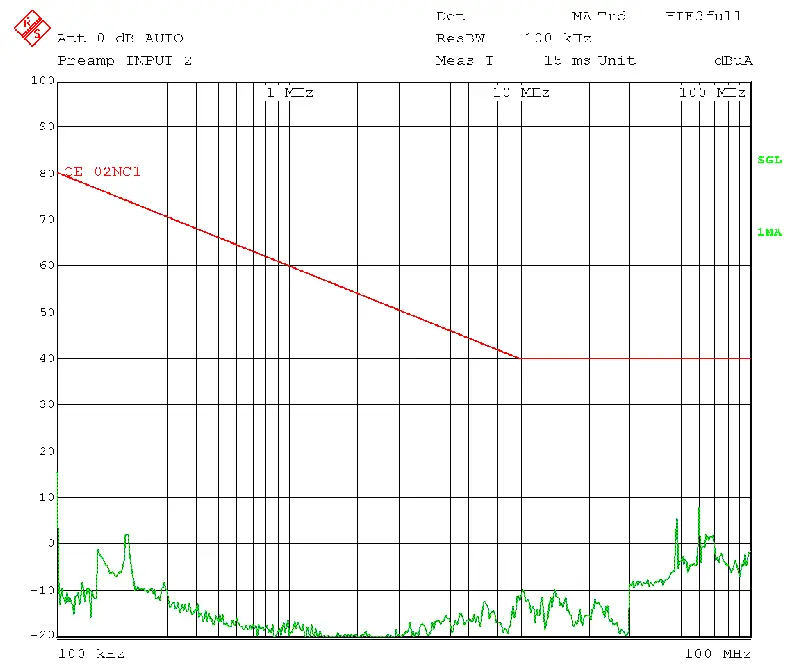
Increasing electrical power introduces another important consideration: electromagnetic compatibility. We have EMC test report of TCU in different versions. Std. variations with PWM control are way below standards, but for some missions with super sensitive precision instrument, that noise was not acceptable & we delivered Linear version of TCU for quiet environments. With new high-rating connectors, it has to show same EMI performance & proved to be so.
The HiPer-D® is designed specifically to provide improved EMI performance compared with conventional D-subminiature implementations. Glenair’s design incorporates a precision-machined metal shell and integrated grounding features intended to improve electromagnetic compatibility. Optional EMI ground springs provide an additional low-impedance path between the connector and its mating shell. In practical terms, the connector helps maintain shielding continuity at one of the most critical points in an electronics enclosure: the transition between the protected electronics and the external harness.
The evolution of spacecraft electronics is increasing the importance of thermal management. As onboard processing power increases, spacecraft designers need greater flexibility not only to remove heat from electronics, but also to provide sufficient heater power to maintain sensitive equipment within its operational temperature range.
Upgraded TCU is designed around this requirement, providing up to 7 A per heater channel and above 4 kW of total input power, while using a high-performance connector technology capable of handling the demands of the power interface. The combination of a high-power TCU architecture with Glenair HiPer-D® Combo connectors demonstrates an important principle in spacecraft electronics design:
Higher system power does not have to mean a larger or more complicated interface.
By combining high-current contacts with robust mechanical construction, environmental sealing and improved EMI performance, the connector becomes an enabling technology for higher-capability thermal-control systems.