Atomic-Level Timing for Space Avionics: LN-CSAC as the Precision Clock Reference in OBC-Hyper-Polar
A stable heartbeat for the spacecraft
- August 19, 2026
- CAVU Aerospace UK
Every spacecraft depends on timing. From the execution of flight software and synchronization of distributed electronics to sensor acquisition, payload operation, data timestamping and communication interfaces, almost every subsystem relies on a clock.
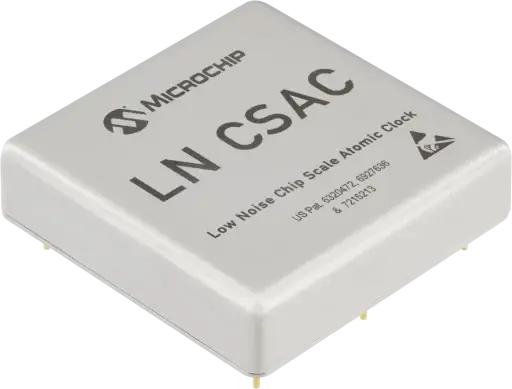
For the OBC-Hyper-Polar, CAVU Aerospace has integrated the Microchip Low-Noise Chip-Scale Atomic Clock (LN-CSAC) & radiation tolerant version of it as a high-precision timing peripheral beside other interface improvement functionality. Rather than allowing each subsystem to depend solely on its own local oscillator, the LN-CSAC can provide a highly stable common frequency and timing reference that can be distributed to other spacecraft subsystems.
This approach gives the spacecraft a more coherent and stable timing architecture: one highly accurate timing source inside the central avionics system, supporting synchronization throughout the spacecraft.
Most digital electronics generate their timing using crystal oscillators. These are compact and effective, but their frequency can be affected by several factors, including temperature variation, aging, mechanical and environmental effects, voltage variations & intrinsic frequency drift. For many ordinary digital functions, these variations are acceptable. However, spacecraft can include payloads and subsystems where timing errors accumulate or where synchronization between different units becomes increasingly important. Precise payload timestamping, high-resolution sensor acquisition, distributed avionics synchronization, RF and communication systems, frequency generation and mixing, inter-satellite synchronization, navigation and positioning functions & scientific instruments and time-correlated measurements are best applications.
A spacecraft operating for months or years cannot always assume continuous access to an external timing reference such as GNSS. A highly stable onboard reference therefore provides an important capability during periods of autonomous or holdover operation.
Combining atomic stability
The Microchip LN-CSAC is particularly interesting because it combines two complementary technologies: an atomic frequency reference for excellent long-term stability and an integrated high-performance Evacuated Miniature Crystal Oscillator for very low phase noise and strong short-term stability. The result is a timing source designed to provide both:
Long-term stability — helping to minimise frequency drift and maintain a highly accurate reference over extended periods.
Short-term spectral purity — providing a clean clock signal with low phase noise for timing-sensitive and frequency-sensitive electronics.
The LN-CSAC provides a 10 MHz sine-wave output and a 1 Pulse Per Second (1PPS) timing output. Published performance includes Allan deviation below 3 × 10⁻¹¹ at a one-second averaging time and phase noise below −120 dBc/Hz at a 10 Hz offset. These characteristics make the device much more than simply a highly accurate clock. It becomes a precision frequency and timing reference for the avionics architecture.
The timing architecture of OBC-Hyper-Polar
In the OBC-Hyper-Polar architecture, the LN-CSAC can operate as the central precision timing source. Conceptually, the architecture can be described as:
LN-CSAC Atomic Reference → Clock Distribution / Conditioning → OBC and Spacecraft Subsystems
The LN-CSAC generates a stable reference frequency, such as its 10 MHz output. This reference can then be distributed directly or through appropriate clock conditioning and distribution circuitry to subsystems requiring a common high-precision reference.
Depending on the spacecraft architecture, the reference can support FPGA and processing subsystem timing references, Payload synchronization, High-precision data acquisition, Communication and RF timing chains, External instrument synchronization, Time-correlated sensor measurements, Frequency synthesis and phase-locked loops & Spacecraft-wide timing distribution. Individual subsystems may still generate their own local operating clocks at hundreds of MHz or GHz. However, those clocks can be derived from, locked to, or periodically calibrated against the common precision reference.
This creates a hierarchy like: atomic reference → master reference frequency → local synthesizers/PLLs → subsystem operating clocks. As a result, the spacecraft can maintain a common frequency foundation even though individual electronic systems operate at very different frequencies.
1PPS Synchronization
In addition to the frequency output, the LN-CSAC provides a 1PPS output, creating a precise timing marker that can be used to establish a common timing epoch across the spacecraft. The 1PPS signal can be distributed to multiple subsystems so that they can align internal counters, timestamp events, trigger measurements or synchronize operations.
At each 1PPS event:
- The OBC establishes or updates the spacecraft timing epoch.
- Payloads align their internal time counters.
- Sensor measurements can be timestamped against the same reference.
- Communication or acquisition systems can synchronise scheduled operations.
- Distributed subsystems maintain a common understanding of spacecraft time.
This is particularly valuable when measurements generated by different instruments must later be correlated on the ground. The LN-CSAC can also accept an external 1PPS reference. Microchip states that this capability can be used to synchronise and discipline the clock to an external reference, allowing the atomic clock to combine external absolute timing with strong onboard holdover performance.
One powerful architecture for a spacecraft is to periodically synchronise the onboard precision clock to an external source when available and then continue operating autonomously when that source is unavailable.
Improved system coherence via common clock
One of the major benefits of integrating the LN-CSAC into the central OBC is that timing can become a managed spacecraft resource. Without a common precision reference, each subsystem may rely on its own independent oscillator. Over time, these clocks can drift relative to one another. Even when every subsystem has a good crystal oscillator, small differences accumulate.
By distributing a common reference, OBC-Hyper-Polar can help establish common frequency reference with all other spacecraft sub-systems, common timing events, Reduced relative drift between subsystems, more consistent timestamping, Improved synchronization between payload and platform & Simplified time correlation during mission operations. This can be particularly important in spacecraft containing multiple sensors or distributed processing units.
Traditional atomic clocks have historically been associated with large, heavy and power-hungry equipment. The chip-scale approach makes atomic timing much more practical for modern embedded and SWaP-constrained systems. Microchip specifies the LN-CSAC with power consumption below approximately 295 mW, a compact form factor and versions supporting a wide operating temperature range.
This makes it possible to integrate a high-performance atomic timing reference directly into an advanced onboard computer architecture rather than requiring a separate, large timing subsystem. For OBC-Hyper-Polar, this means precision timing can be integrated alongside the main processing, FPGA and avionics functions. With the integration of Microchip’s Low-Noise Chip-Scale Atomic Clock, OBC-Hyper-Polar extends its role beyond onboard computing—providing a platform capable of distributing a highly precise and stable timing reference to the wider spacecraft avionics system.